QYLD Dividend Yield 2026: Monthly Payments, History & Income Guide
Why QYLD Pays a 12% Yield — and What's the Catch
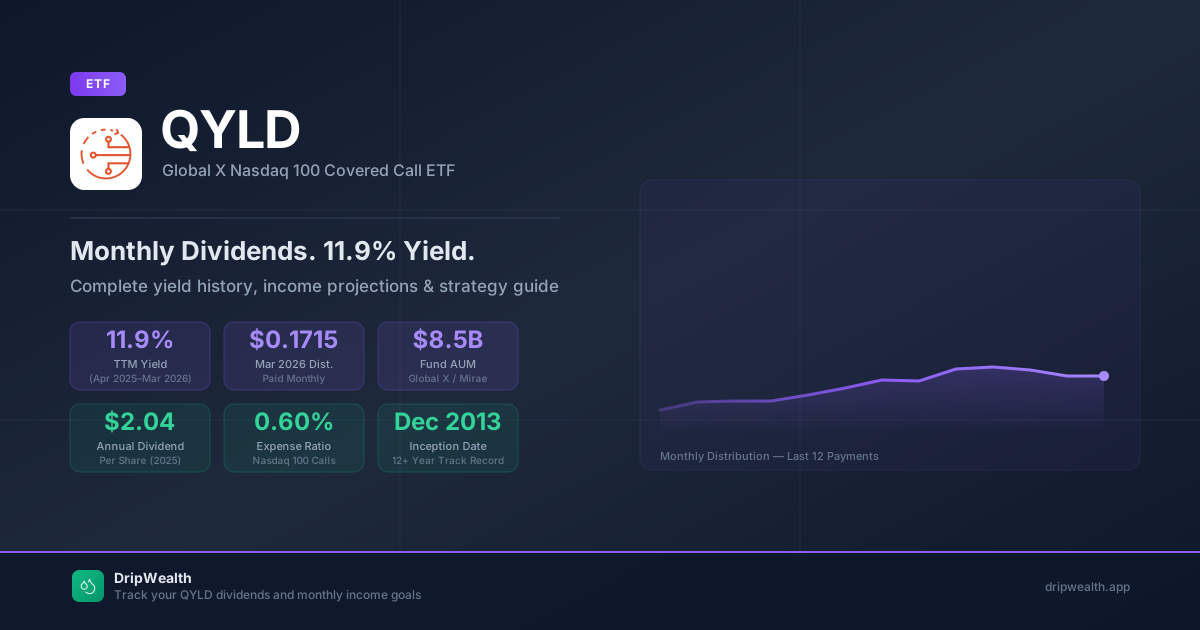
When income investors first discover QYLD, the reaction is almost always the same: "Nearly 12% yield, paid every month — what's the catch?"
The answer is nuanced. QYLD — the Global X Nasdaq 100 Covered Call ETF — genuinely delivers what it promises: consistent monthly distributions at a yield that dwarfs almost every other investment you can buy on the stock market. But the strategy that generates that income comes with real trade-offs that every investor needs to understand before buying a single share.
In this guide, you'll get the complete QYLD distribution history, income projections at every portfolio size, a direct comparison with JEPI and JEPQ, the tax treatment most investors miss, and an honest assessment of when QYLD makes sense — and when it doesn't.
How QYLD Generates Its Income: The Covered Call Strategy
QYLD doesn't own dividend stocks. It doesn't collect rent or interest. Its income comes from one thing: selling covered call options on the Nasdaq 100 index (QQQ).
Here's how it works in plain English:
- QYLD holds the stocks that make up the Nasdaq 100 (Apple, Microsoft, Nvidia, Amazon, etc.)
- Each month, it sells call options against that entire portfolio — promising to sell the stocks at a set price in exchange for a cash premium
- The premiums collected from selling those options become your monthly distribution
The premium income is substantial because the Nasdaq 100 is a volatile, high-growth index — and volatility is what option sellers get paid for. When markets are nervous and implied volatility is high (like during bear markets), QYLD collects bigger premiums. When markets are calm and grinding upward, premiums shrink.
How it works: QYLD sells at-the-money covered calls, meaning it gives up essentially all upside above the current index level each month. If the Nasdaq 100 rises 5% in a month, QYLD doesn't capture most of that gain — it gave it away in exchange for the option premium.
This is the core trade-off. You get high monthly income. You give up capital appreciation. Over time, this means QYLD's share price has drifted lower as markets have risen — but the income stream has remained remarkably consistent.
Track your QYLD monthly dividends with DripWealth
Add QYLD to DripWealth and we'll track every payout, ex-date, and yield change for you — free to start.
QYLD Dividend History: Every Monthly Payment (2022–2026)
QYLD has paid a distribution every single month since inception in December 2013. The amount varies with market conditions, but the payment cadence has never broken. Here's the recent history:
| Year | Annual Dist. | Avg Monthly | Approx. Yield |
|---|---|---|---|
| 2026 (TTM) | $2.04 | $0.170 | ~11.9% |
| 2025 | $2.04 | $0.170 | ~12.0% |
| 2024 | $2.28* | $0.183 | ~12.1% |
| 2023 | $2.03 | $0.169 | ~12.4% |
| 2022 | $2.06 | $0.172 | ~14–16%** |
*2024 includes a $0.339 supplemental year-end distribution in December. **2022 yield was elevated because the share price fell during the bear market, boosting the yield percentage.
The most important takeaway: QYLD has consistently paid $2.00–$2.30 per share per year for multiple years. The distribution is variable month-to-month, but the annual total has been remarkably stable.
Here are the most recent 12 monthly payments (April 2025 through March 2026):
| Ex-Date | Distribution/Share | Payment Date |
|---|---|---|
| Mar 23, 2026 | $0.1715 | Mar 26, 2026 |
| Feb 23, 2026 | $0.1771 | Feb 26, 2026 |
| Jan 20, 2026 | $0.1786 | Jan 23, 2026 |
| Dec 22, 2025 | $0.1779 | Dec 30, 2025 |
| Nov 24, 2025 | $0.1728 | Dec 2, 2025 |
| Oct 20, 2025 | $0.1731 | Oct 27, 2025 |
| Sep 22, 2025 | $0.1704 | Sep 29, 2025 |
| Aug 18, 2025 | $0.1677 | Aug 25, 2025 |
| Jul 21, 2025 | $0.1653 | Jul 28, 2025 |
| Jun 23, 2025 | $0.1657 | Jun 30, 2025 |
| May 19, 2025 | $0.1650 | May 27, 2025 |
| Apr 21, 2025 | $0.1598 | Apr 28, 2025 |
Notice something important: QYLD pays within 3–5 days of the ex-date. That's much faster than most ETFs or stocks — you don't wait weeks for your cash.
How Much Monthly Income Can You Generate with QYLD?
At a TTM yield of ~11.9% and a share price of ~$17.15, the math is straightforward. Here's what a QYLD position would generate at different investment sizes — using the current $0.1715 monthly distribution:
| Investment | Shares | Monthly Income | Annual Income |
|---|---|---|---|
| $5,000 | 292 | ~$50 | ~$597 |
| $10,000 | 583 | ~$100 | ~$1,194 |
| $25,000 | 1,458 | ~$250 | ~$2,986 |
| $50,000 | 2,915 | ~$500 | ~$5,972 |
| $100,000 | 5,830 | ~$999 | ~$11,943 |
| $250,000 | 14,577 | ~$2,500 | ~$29,860 |
Compare this to JEPI's ~8% yield: you'd need ~$150,000 in JEPI to generate the same $1,000/month income that QYLD produces from ~$100,000. That gap is real and significant.
Tip: Track your QYLD income alongside your other holdings — including when each monthly distribution lands — with DripWealth's free dividend tracker. Connect your brokerage or add QYLD manually to see your projected monthly income in real time.
QYLD vs JEPI vs JEPQ: Which Covered Call ETF Is Best?
All three are monthly-paying covered call ETFs, but they operate on very different indexes and with meaningfully different approaches. Here's a direct comparison:
| Feature | QYLD | JEPI | JEPQ |
|---|---|---|---|
| Underlying Index | Nasdaq 100 | S&P 500 | Nasdaq 100 |
| Call Strategy | 100% ATM calls | ~20% ELN calls | ~20% ELN calls |
| TTM Yield | ~11.9% | ~8.0% | ~11.5% |
| Expense Ratio | 0.60% | 0.35% | 0.35% |
| AUM | ~$8.5B | ~$43B | ~$20B |
| Upside Participation | Very Low | Moderate | Moderate |
| Tax Treatment | Ordinary income | Mostly ordinary | Mostly ordinary |
| Best For | Max income now | Income + stability | Income + growth |
The key difference is QYLD's fully-covered call strategy. JEPI and JEPQ only write calls on roughly 20% of their portfolio through equity-linked notes, allowing them to capture some upside when markets rally. QYLD writes calls on the entire portfolio, maximizing income but capturing almost no upside.
For a deeper comparison of JEPI and JEPQ specifically, see our JEPQ vs JEPI comparison guide.
QYLD Tax Treatment: What You Actually Owe the IRS
This is the section most people skip — and then regret come tax season.
QYLD's distributions are classified as ordinary income, not qualified dividends. This matters a lot. Qualified dividends are taxed at the long-term capital gains rate (0%, 15%, or 20% depending on your income). Ordinary income is taxed at your regular marginal tax rate — which for many investors is 22%, 24%, or higher.
Tax warning: At an 11.9% gross yield, a 22% marginal tax rate reduces your after-tax yield to about 9.3%. At 32%, you're down to ~8.1%. QYLD works best in tax-advantaged accounts (IRA, Roth IRA) where distributions grow tax-deferred or tax-free.
The exception is return-of-capital (ROC) distributions. QYLD occasionally classifies a portion of its distributions as ROC, which reduces your cost basis instead of being taxed immediately. This effectively defers taxes until you sell — but it complicates your recordkeeping. Check QYLD's year-end 1099 to see the exact breakdown each year.
Bottom line on taxes:
- In a taxable account: QYLD's effective yield shrinks significantly due to ordinary income treatment
- In a traditional IRA: distributions are taxed as ordinary income when you withdraw, but grow tax-deferred until then
- In a Roth IRA: QYLD is potentially ideal — all that income compounds completely tax-free
Who Should Own QYLD — and Who Shouldn't
After understanding the strategy, here's a practical framework for deciding if QYLD belongs in your portfolio:
QYLD might be right for you if:
- You need reliable monthly income and are in or near retirement
- You hold QYLD in a Roth IRA where distributions compound tax-free
- You want to supplement Social Security or other income sources
- You already have growth assets (QQQ, S&P 500) elsewhere and want an income layer
- You want higher yield than JEPI and can accept lower upside participation
QYLD is probably not right for you if:
- You're 30 years old and building wealth — you'll significantly underperform QQQ
- You hold it in a taxable account and are in a high tax bracket
- You plan to reinvest all distributions — just buy QQQ instead
- You expect QYLD to "recover" to $25 — the price erosion is structural, not temporary
Portfolio approach: Many income investors use QYLD as one of several income sources alongside JEPI, SCHD, and individual dividend stocks. A blended approach gives you the high yield of QYLD, the stability of JEPI, and the dividend growth of SCHD — see our covered call ETF comparison for how to think about the mix.
How to Buy QYLD and Start Collecting Monthly Distributions
QYLD trades on the Nasdaq exchange under the ticker symbol QYLD. You can buy it through any major brokerage — Fidelity, Schwab, Vanguard, Robinhood, TD Ameritrade, or Interactive Brokers — just like buying a stock.
A few practical points before you buy:
- Ex-dividend date is key. You must own QYLD before the ex-date (typically the third Monday of the month) to receive that month's distribution. The payment arrives within 3–5 days of the ex-date — much faster than most ETFs.
- DRIP is available. Most brokerages let you automatically reinvest QYLD distributions. But remember: if you're reinvesting in a taxable account, you still owe taxes on the ordinary income even if you never see the cash.
- Consider account location first. Max out your Roth IRA with QYLD before investing in a taxable account. The tax-free compounding is enormously valuable on a 12% yielding asset.
Once you've bought QYLD, track your monthly distributions and project your annual income with DripWealth — you can see exactly how your total dividend income compounds over time across all your holdings.
The dividend income community loves QYLD for one simple reason: it delivers. Every month, the distributions land like clockwork. Whether that income is the right fit for your financial situation is the question only you can answer — but now you have everything you need to decide.