AT&T Dividend (T): 3.9% Yield, Cut History & Safety in 2026
AT&T After the Cut: A 3.9% Yield With a Very Different Story
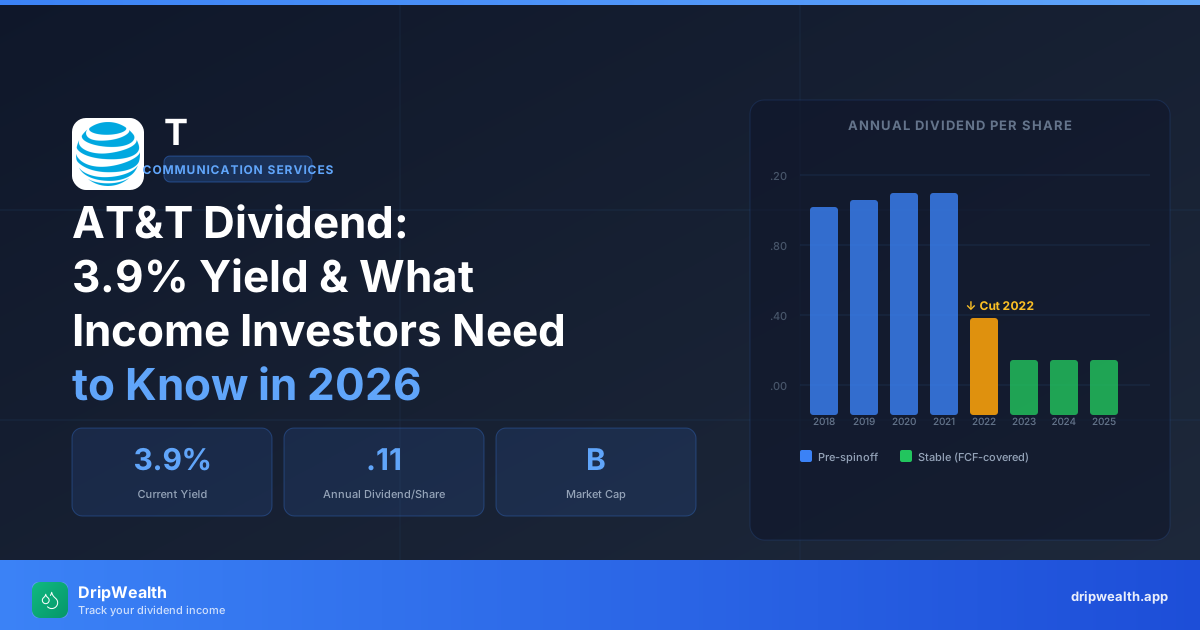
If you searched "AT&T dividend" expecting a long streak of consecutive increases, you're going to find something unusual. T cut its dividend by 47% in 2022 — one of the most headline-grabbing dividend reductions in recent memory.
And yet, AT&T still pays a 3.9% yield on a stock trading around $28. That's nearly double the S&P 500 average. It generates $19+ billion in free cash flow annually. And its dividend payout ratio on free cash flow is a comfortable 40% — far safer than it was before the cut.
The story of T stock in 2026 isn't about the cut. It's about what came after: a leaner company, a focused telecom operator, and a dividend that's actually built to last.
In this guide, we'll walk through AT&T's full dividend history, exactly why the cut happened, whether the $1.11 annual payout is safe today, how much income T generates across different investment sizes, and what the company's fiber and 5G expansion means for future dividend growth.
AT&T Dividend History: From Growth Streak to Cut and Stability
For decades, AT&T was celebrated as one of the most reliable dividend payers in America. For many investors, it was a core income holding — the kind of stock you owned alongside Coca-Cola and Johnson & Johnson. Then 2022 changed everything.
Here's AT&T's annual dividend per share over the past 11 years:
| Year | Annual Dividend/Share | YoY Change | Note |
|---|---|---|---|
| 2015 | $1.88 | +2.2% | DirecTV acquisition era |
| 2016 | $1.92 | +2.1% | |
| 2017 | $1.96 | +2.1% | Time Warner bid announced |
| 2018 | $2.00 | +2.0% | Time Warner deal closed |
| 2019 | $2.04 | +2.0% | WarnerMedia operating |
| 2020 | $2.08 | +2.0% | Final year of "old" T |
| 2021 | $2.08 | Flat | Spinoff announced |
| 2022 | $1.35 | −35% | WarnerMedia spinoff — cut year |
| 2023 | $1.11 | Stabilized | New quarterly rate: $0.2775 |
| 2024 | $1.11 | Flat | Debt reduction in progress |
| 2025 | $1.11 | Flat | FCF +5%, fiber growth |
The full-year 2022 number reflects partial payments at the old rate before the reset, which is why it shows $1.35. The new quarterly rate of $0.2775 was set in mid-2022 and has held steady ever since.
Key context: AT&T's pre-2022 dividend was partially funded by borrowing and stretched finances from the DirecTV and Time Warner acquisitions. The "new" $1.11 dividend is backed by genuine free cash flow — it's structurally stronger than what came before.
Track your AT&T dividends with DripWealth
Add T to DripWealth and we'll track every payout, ex-date, and yield change for you — free to start.
Why AT&T Cut Its Dividend 47% in 2022
The 2022 cut wasn't a crisis — it was a strategic reset. Here's what happened:
In 2018, AT&T completed its acquisition of Time Warner (WarnerMedia) for $85 billion, adding massive debt to its balance sheet. Add DirecTV ($67B in 2015), and AT&T had accumulated over $150 billion in debt — making it one of the most indebted companies on the planet.
By 2021, AT&T announced it would spin off WarnerMedia and merge it with Discovery to form Warner Bros. Discovery (WBD). The deal closed in April 2022. With WarnerMedia gone, AT&T's revenues dropped significantly — and a $2.08/year dividend was simply unsustainable on the remaining telecom business alone.
Management's logic was straightforward:
- Cut the dividend to match the actual cash-generating capacity of "T 2.0" (telecom-only AT&T)
- Use freed-up cash to aggressively pay down the $150B+ debt load
- Invest in fiber and 5G network buildouts to drive long-term growth
- WBD shareholders got WBD stock as compensation — it wasn't a "loss" for original T holders, it was a separation
Important for new investors: If you bought T after April 2022, you only own the telecom business. You never had the WarnerMedia piece. The $1.11 dividend is what "pure AT&T" pays — and it's well-covered.
The debt/EBITDA ratio tells the story of the transformation:
| Year | Net Debt / EBITDA | Status |
|---|---|---|
| 2021 | 4.47× | Dangerously high |
| 2022 | 2.59× | Post-spinoff reset |
| 2023 | 1.83× | Improving |
| 2024 | 1.45× | Near investment-grade target |
| 2025 | 1.96× | Stable — manageable |
Debt is still there, but it's no longer the existential risk it once was.
Is the AT&T Dividend Safe in 2026?
This is the question every T investor asks. The answer, based on the numbers, is yes — with a caveat.
The math is compelling. AT&T generated $19.4 billion in free cash flow in 2025. The company pays roughly $7.8 billion in annual dividends (based on ~7 billion shares outstanding at $1.11/year). That leaves a comfortable cushion:
A 40% FCF payout ratio is extremely conservative for a large-cap telecom. Compare that to Verizon at roughly 55–60% or many REITs that pay out 80–90%. AT&T has over $11 billion in post-dividend free cash flow to pay down debt, reinvest in the network, and potentially grow the dividend.
Revenue has also been steady: $125.6 billion in 2025 (up from $122.3B in 2024), driven by wireless subscriber growth and AT&T Fiber's ongoing expansion. AT&T now passes 28+ million locations with fiber, and that subscriber base is growing.
Bottom line: At a 40% FCF payout ratio, T would need to see a catastrophic 60% drop in free cash flow before the dividend was threatened. That's not happening in telecom — a business with sticky recurring revenue and little sensitivity to economic cycles.
How Much Income Does AT&T Generate Per Month?
At $28 per share and $1.11 annually, here's what different investment sizes in T would produce:
| Investment | Shares (~$28) | Annual Income | Monthly Income |
|---|---|---|---|
| $5,000 | 178 | $198 | $16 |
| $10,000 | 357 | $396 | $33 |
| $25,000 | 893 | $991 | $83 |
| $50,000 | 1,786 | $1,983 | $165 |
| $100,000 | 3,571 | $3,964 | $330 |
| $200,000 | 7,143 | $7,929 | $661 |
AT&T pays quarterly (typically in February, May, August, and November), so the income arrives in four chunks per year. If you want truly monthly income, you'd need to pair it with a monthly payer like Realty Income or a covered call ETF like JEPI.
AT&T Fiber and 5G: The Path to Dividend Growth
For income investors, the billion-dollar question isn't whether T can maintain its dividend — it's when AT&T will start growing it again.
The answer lies in AT&T's two major growth engines: AT&T Fiber and 5G wireless.
AT&T Fiber has been a standout performer. The company has been building out its fiber broadband network aggressively, passing millions of new locations every year. Fiber customers tend to have higher ARPU (average revenue per user), lower churn, and often bundle with wireless service. As more fiber subscribers come online, recurring cash flows should rise.
5G wireless is AT&T's other growth pillar. Postpaid phone net adds have been positive for several consecutive quarters. AT&T's FirstNet (priority network for first responders) contract has also proven to be a durable competitive advantage that boosts subscriber counts.
Management has guided toward low-to-mid single-digit dividend growth beginning around 2026–2027 as debt ratios reach target levels. No promises — but the direction of travel is positive. With free cash flow growing year over year and debt metrics improving, a $1.14 or $1.18 annual dividend isn't out of the question in the next two years.
Tip: AT&T has historically paid an ex-dividend date around 3 weeks before the payment. For 2026, quarterly payments have been January 2 (record: Oct 10), April 1 (record: Jan 12), and upcoming Q3/Q4 dates. Check the investor relations page for exact dates.
AT&T vs. Verizon: Which Telecom Dividend Is Better?
The perennial debate for telecom income investors: T or VZ? Here's where they stand today:
| Metric | AT&T (T) | Verizon (VZ) |
|---|---|---|
| Annual Dividend | $1.11 | ~$2.66 |
| Dividend Yield | ~3.9% | ~6.2% |
| FCF Payout Ratio | ~40% | ~55–60% |
| Debt / EBITDA | ~2.0× | ~2.5× |
| Dividend Growth Streak | Flat since 2022 | 18+ years |
| Growth Outlook | Fiber + 5G upside | Slower subscriber growth |
Verizon offers a higher current yield and an unbroken dividend growth streak. AT&T offers a lower payout ratio, improving debt metrics, and arguably better growth prospects via fiber. If you want maximum income today, VZ wins. If you want the better chance of dividend growth tomorrow, T may have the edge.
Many dividend investors own both — they're uncorrelated enough in their business strategies that together they form a solid telecom income foundation.
AT&T Dividends: Qualified or Ordinary Income?
AT&T dividends are generally classified as qualified dividends for US taxpayers who hold the stock in a taxable account and meet the holding period requirement (61 days within the 121-day window around the ex-dividend date).
Qualified dividends are taxed at the long-term capital gains rate — 0%, 15%, or 20% depending on your income bracket — rather than ordinary income rates which can reach 37%. For most investors, that's a meaningful tax advantage.
Tax note: If you hold T in a 401(k) or IRA, the qualified vs. ordinary distinction doesn't matter — all distributions are taxed as ordinary income on withdrawal. For tax efficiency in taxable accounts, the qualified dividend status is a genuine benefit.
Who Should Own AT&T Stock?
AT&T is a stock for investors who want steady income from a massive, defensive business — and who aren't expecting explosive capital appreciation.
T makes sense if you:
- Want a 3.9% yield backed by $19B+ in free cash flow
- Value dividend safety over dividend growth — the 40% payout ratio is one of the lowest in large-cap telecom
- Want low volatility — T has a beta of 0.54, meaning it moves roughly half as much as the market
- Believe in the fiber buildout — AT&T Fiber is a genuine growth story within a slow-growth sector
- Are patient about dividend growth — increases may resume in 2027 as debt targets are met
T is not the right fit if you want dividend growth now, or if you're hoping for significant capital gains. This is a classic income stock: you buy it for the check, not the appreciation.
If you're building an income portfolio that generates $500+ per month, AT&T can be a solid anchor position alongside higher-growth payers like Microsoft or SCHD.
Track your AT&T income with DripWealth
Add T to your portfolio, see dividend predictions, and track quarterly payments automatically.
Get Started Free