SCHD Dividend Yield 2026 (Updated): History, Growth Rate, and Income Guide
Why SCHD Is America's Favorite Dividend Growth ETF
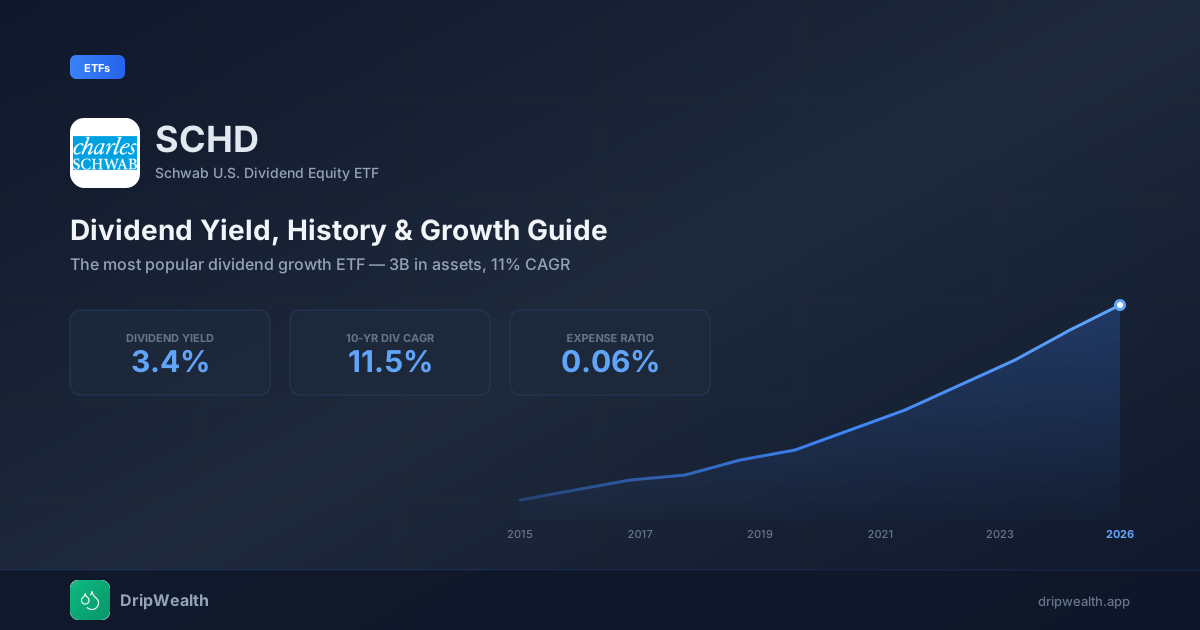
There are over 2,000 ETFs listed in the United States. Out of all of them, one dividend fund has captured the hearts — and the portfolios — of income investors everywhere. That fund is SCHD, the Schwab U.S. Dividend Equity ETF, and it just announced its Q1 2026 dividend of $0.2569 per share.
With $83 billion in assets under management, SCHD isn't just popular — it's the single most-held dividend ETF in America. And for good reason. It combines a quality-first stock selection process, a rock-bottom 0.06% expense ratio, and a dividend that has grown at an 11.5% compound annual rate over the past decade.
That means SCHD's dividend has roughly tripled since 2015. If you had invested $100,000 in SCHD ten years ago, your income stream alone would have grown from about $2,000/year to over $6,000/year — without adding a single dollar. That's the power of dividend growth investing in a single ETF.
In this guide, we'll cover SCHD's full dividend history, its stock selection methodology, income projections at every portfolio size, how it compares to JEPI and VYM, its top holdings after the March 2026 reconstitution, and why it remains the gold standard for dividend growth investors.
Want near-term payout timing too? Use our ex-dividend stocks this week and record-date stocks this week trackers.
How SCHD Selects Its 100 Dividend Stocks
SCHD doesn't just buy the highest-yielding stocks and call it a day. It tracks the Dow Jones U.S. Dividend 100 Index, which uses a rigorous quality-first screening process to find companies that can sustain and grow their dividends over time.
The starting requirement is strict: a company must have paid dividends for at least 10 consecutive years. That immediately eliminates thousands of stocks and ensures only proven dividend payers make the cut.
From that universe, the index ranks stocks on four fundamental quality factors:
Importantly, SCHD excludes REITs, MLPs, and preferred stocks. This makes it highly tax-efficient since nearly all dividends qualify for the lower qualified dividend tax rate — a major advantage over income-focused ETFs like JEPI.
The index reconstitutes annually each March, swapping out stocks that no longer meet the criteria and adding new qualifiers. It also rebalances quarterly to keep position sizes in check.
This disciplined, rules-based approach is what separates SCHD from many dividend ETFs that simply chase the highest yields. By focusing on quality and growth, SCHD avoids the "yield traps" that plague high-dividend strategies.
Track your SCHD dividends with DripWealth
Add SCHD to DripWealth and we'll track every payout, ex-date, and yield change for you — free to start.
SCHD Dividend History: Every Year Since 2015
SCHD's dividend track record tells a compelling story of consistent, accelerating growth. The fund executed a 3-for-1 stock split in October 2024, so all figures below are split-adjusted to make comparisons apples-to-apples.
The numbers speak for themselves. SCHD's 10-year dividend CAGR is 11.5% and its 5-year CAGR is 9.2%. Even in the "slowest" year (2023, at +3.8%), the dividend still grew — there has never been a cut or a freeze since inception.
Notice the standout years: 2019 (+19.8%) and 2020 (+17.7%). While the broader market panicked during COVID, SCHD's underlying holdings continued raising their dividends. That's the quality factor at work.
Latest Q1 2026 Dividend: $0.257 Per Share
SCHD just announced its first quarterly dividend of 2026 this week. Here are the details:
Compared to Q1 2025's dividend of $0.2488 per share, this represents a +3.3% year-over-year increase. Q1 is typically SCHD's smallest quarterly payment — the fund tends to have its largest dividend in Q4 when many of its underlying holdings pay special or accelerated dividends.
Here's the recent quarterly payment schedule for context:
Notice how Q4 2025 was the largest payment at $0.2858, nearly 11% more than Q1. This seasonality is typical — Q4 dividends often get a bump from year-end distributions. The next expected ex-dividend date is around June 24, 2026 for Q2.
If SCHD maintains its trailing growth trajectory, the full-year 2026 dividend could land around $1.08–$1.12 per share, split-adjusted — continuing the march toward $1.20+ by 2028.
Income Projections: How Much SCHD Pays at Every Portfolio Size
One of the most common questions from SCHD investors: "How much income will I actually get?" Here's a straightforward breakdown at today's share price of approximately $30.63 and an annualized dividend of ~$1.05 per share (trailing twelve months, split-adjusted).
Here's the math for the $100K example: $100,000 ÷ $30.63 = ~3,265 shares × $1.05 = $3,428/year or about $286/month in dividend income. Not bad for a single ETF position.
And remember — these projections are based on today's dividend. At SCHD's historical 11.5% growth rate, that $3,428/year becomes roughly $6,500/year in just six years, without investing another penny. That's the magic of dividend growth compounding.
Want to see how different portfolio sizes translate to monthly income? Check out our guide on how to build a $500/month dividend portfolio.
SCHD vs JEPI vs VYM: Which Dividend ETF?
The three most popular dividend ETFs each serve a different purpose. Here's how they stack up head-to-head:
SCHD is the clear winner for investors who want growing income and total return. Its dividend doubles roughly every 6 years, which means a 3.4% yield today becomes a 6.8% yield-on-cost in six years if the growth continues. Over 10-20 year horizons, that compounding is extremely powerful.
JEPI excels at one thing: maximum current income. Its ~8.4% yield is roughly 2.5x SCHD's, making it ideal for retirees who need cash now. But JEPI's income doesn't grow — it's generated from options premiums that fluctuate — and the distributions are taxed as ordinary income. Read our full JEPI dividend guide for more.
VYM sits in between — broader diversification (400+ stocks) with a lower yield but decent growth. It's a solid "set it and forget it" choice but lacks SCHD's quality screening edge.
Total Return Performance: Why SCHD Beats Most Dividend Funds
Dividend growth is only half the story. What really matters is total return — dividends plus price appreciation. And SCHD has delivered impressively on both fronts.
SCHD's 10-year annualized total return is approximately 13.0%. That includes the rough patches — 2022's tech-driven sell-off hit SCHD less than the S&P 500 (SCHD fell just -3.3% vs the S&P's -18.1%), and the 2023 "Magnificent Seven" rally left value-oriented funds like SCHD behind temporarily.
But the bigger picture is clear: dividend growth + price appreciation = powerful compounding. A $10,000 investment in SCHD at inception in 2011 would be worth roughly $45,000 today, with dividends reinvested. And the income stream from that original investment has grown every single year.
2021 was the standout year at +35.6%, driven by the value rotation and economic reopening. SCHD's heavy weighting in financials, industrials, and energy paid off massively as those sectors surged.
Top 10 Holdings After March 2026 Reconstitution
SCHD just completed its annual index reconstitution in March 2026, bringing in several new high-quality names. Here are the current top 10 holdings, which together make up roughly 40% of the portfolio:
The portfolio is well-diversified across sectors: energy (CVX, COP), healthcare (MRK, UNH, ABT, AMGN), technology (TXN), telecom (VZ), and consumer staples (KO, PEP). No single sector dominates, and the maximum position size is capped at roughly 4.6%.
The addition of UnitedHealth (UNH) and Abbott Labs (ABT) in the March 2026 reconstitution is notable — both are premium healthcare companies with strong dividend growth histories. UNH has grown its dividend at 16%+ annually for the past five years, while ABT has increased for 52 consecutive years (a Dividend King).
Want to dive deeper into individual holdings? Read our guides on Chevron (CVX) and Coca-Cola (KO) for complete dividend histories and analysis.
Start Tracking Your SCHD Dividends
SCHD is the kind of ETF you buy, hold, and let compound for decades. But to truly appreciate the power of its growing dividend, you need to track it.
Add SCHD to your portfolio and automatically track quarterly payments, project future income, see your dividend growth over time, and chart your path to financial independence.
Get Started FreeWith DripWealth, you can:
Whether you're just starting with your first 100 shares or building toward a six-figure SCHD position, DripWealth helps you visualize the power of dividend compounding every step of the way.
For a deeper comparison of dividend growth ETFs, check out our detailed SCHD vs VYM vs DGRO comparison.