Chevron Dividend: CVX Yield, 38-Year Streak & Income Guide (2026)
Why Chevron Is the Energy Dividend Stock You Want to Own
Energy stocks get a bad rap in the dividend world. They're "too cyclical," "too tied to oil prices," "too risky." And for most energy companies, that's fair. Earnings swing wildly, dividends get cut when crude drops, and investors are left holding the bag.
Chevron is the exception.
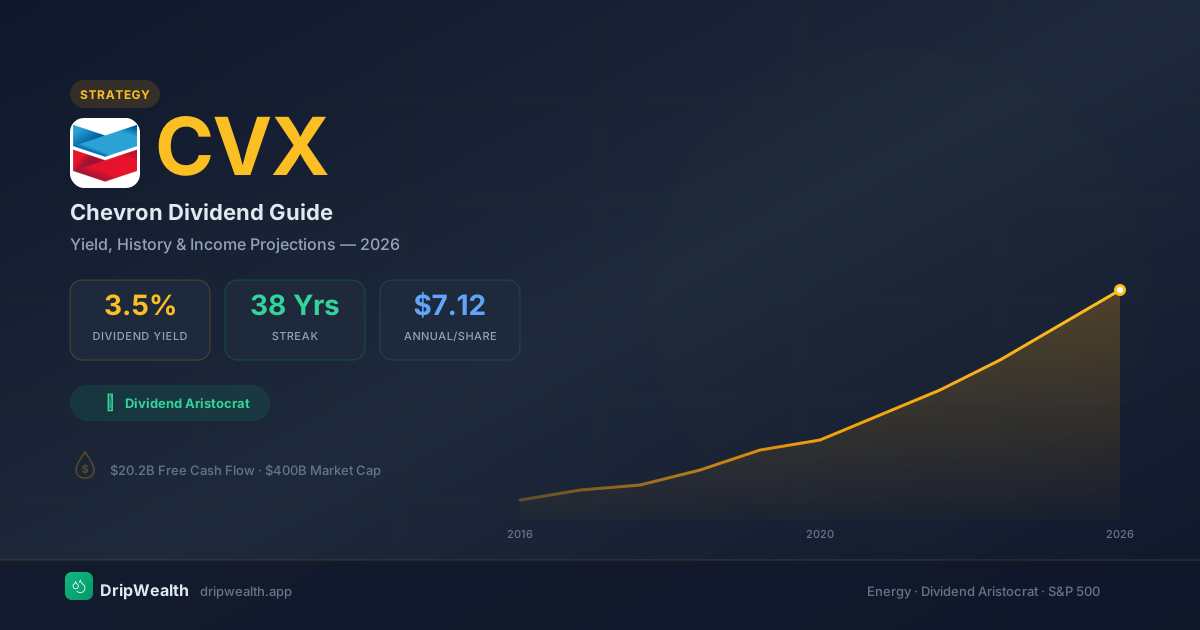
While other energy giants slashed their dividends during the 2020 oil crash, Chevron not only maintained its payout — it raised it. That's because CVX has now increased its dividend for 38 consecutive years, earning it Dividend Aristocrat status. Only a handful of energy companies in the entire S&P 500 can say that.
At around $202 per share, Chevron yields roughly 3.5% — more than double the S&P 500 average. It generated $20.2 billion in free cash flow in 2025 and returned a record $27 billion to shareholders through dividends and buybacks. That's not a company stretching to pay its dividend. That's a cash machine.
In this guide, we'll break down Chevron's full dividend history, growth trajectory, how much income CVX generates at every portfolio size, why the dividend is safer than earnings alone suggest, and how it stacks up against other energy majors.
38 Consecutive Years of Dividend Increases — A True Aristocrat
Chevron's dividend streak stretches back to 1988. Through Gulf Wars, oil crashes, the 2008 financial crisis, and a global pandemic, CVX never once cut or froze its payout. That 38-year streak puts it firmly in Dividend Aristocrat territory — and it's closing in on the 50 years needed for Dividend King status.
The growth rate has been impressively consistent, even through oil's notorious boom-bust cycles. Even in 2015-2016 — when crude crashed below $30 and most energy companies slashed dividends — Chevron still managed to eke out modest increases.
From $4.29 in 2016 to $7.12 in 2026 — that's a 66% increase in annual dividend income over a decade. And the growth has been accelerating recently: the 5-year CAGR of 5.8% outpaces the 10-year CAGR of 4.8%, suggesting Chevron's management is becoming more aggressive with shareholder returns.
Note: During the 2015-2016 oil crash, Chevron raised its dividend by just 0.2% and 0.7% — the smallest increases in its streak. But it never froze or cut. That discipline through extreme adversity is what separates Aristocrats from pretenders.
Track your Chevron dividends with DripWealth
Add CVX to DripWealth and we'll track every payout, ex-date, and yield change for you — free to start.
CVX Dividend Dates and Recent Payments
Chevron pays dividends quarterly, typically in March, June, September, and December. The ex-dividend date usually falls about two weeks before the payment date. Here's the recent schedule:
Chevron typically announces its annual dividend increase in January, effective with the Q1 payment. The most recent increase — from $1.71 to $1.78 per share — was a 4.1% raise announced in January 2026.
Tip: Want to know exactly when your next CVX dividend lands? Add Chevron to your DripWealth portfolio and we'll predict your upcoming payments with dates and amounts.
How Much Dividend Income Does CVX Pay? (By Portfolio Size)
Chevron's ~3.5% yield makes it one of the higher-yielding blue chips in the S&P 500 — significantly more than tech names like Microsoft (~0.9%) or Apple (~0.5%), and comparable to classic income stocks like Coca-Cola (~2.7%). Here's what CVX pays at various investment sizes at today's ~$202 share price:
A $50,000 position in Chevron generates over $1,750 per year in dividends — nearly $150/month. And that's at today's rate. At ~5.8% annual dividend growth, that $1,765 becomes $2,340 in 5 years and $3,100 in 10 years without investing another dollar.
CVX is an excellent anchor for a $500/month dividend portfolio — you get a healthy starting yield and meaningful growth, which is a combination many high-yielders can't match.
The income math: $50,000 in CVX at 3.5% yield with ~5.8% annual growth = $1,765/yr today, growing to $2,340 in 5 years, $3,100 in 10 years. That's inflation-beating passive income from a single position.
Dividend Safety: Can Chevron Keep Raising Through Oil Cycles?
Here's the number that makes some investors nervous: Chevron's trailing earnings payout ratio recently topped 100%. On the surface, that means Chevron paid out more in dividends than it earned. Is the dividend in danger?
No. And here's why.
Energy company earnings swing wildly with oil prices. In 2022 when Brent hit $100+, Chevron earned over $18 per share. In 2025, with oil closer to $70, earnings dropped to $6.65. But the dividend — at $6.84 — barely budged. This is by design. Chevron manages its dividend to its long-term cash flow capacity, not its short-term earnings.
The key metric for energy companies is free cash flow payout ratio, not earnings payout. Chevron's dividend cost roughly $12 billion in 2025, while FCF was $20.2 billion — that's a very comfortable ~60% FCF payout ratio. The remaining cash goes to buybacks and debt reduction.
And the safety cushion is growing. Chevron's Tengiz expansion project in Kazakhstan came online in early 2025, adding up to 260,000 barrels per day. The field alone is projected to generate $5 billion in free cash flow in 2026 at just $60 oil. Meanwhile, Permian Basin output holds steady at 1 million barrels per day.
The safety buffer: If oil prices collapse and Chevron needs to cut costs, the first thing management dials back is share buybacks ($2.5-3B), not dividends ($12B). The buyback program acts as a built-in shock absorber for the dividend.
Yield on Cost: How CVX Turns 3.5% Into 9%+
Chevron's 3.5% starting yield is already well above the S&P 500 average. But the real magic happens when you hold for a decade or more and let dividend growth compound your yield on cost.
The math is straightforward: you lock in today's price, and each annual dividend increase raises your effective yield on the original investment. At Chevron's 5-year CAGR of ~5.8%, your yield on cost grows rapidly.
By year 10, your effective yield on cost reaches roughly 6.2%. By year 20, you're north of 10% — earning back a tenth of your original investment in dividends every single year.
To put this in dollar terms: someone who invested $50,000 in CVX today would be collecting roughly $5,400/year in dividends 20 years from now — assuming the same 5.8% growth rate and without adding another penny. That's more than most savings accounts pay on the entire principal.
This is why the dividend snowball strategy works so well with Aristocrats like Chevron. You're not just buying income — you're buying an income stream that accelerates over time.
CVX vs. XOM, COP, EOG: How Chevron Compares to Energy Peers
Chevron isn't the only energy stock paying dividends. So how does it stack up against the competition? Here's how CVX compares to the other major energy dividend payers:
| Metric | CVX | XOM | COP |
|---|---|---|---|
| Current Yield | ~3.5% | ~3.4% | ~2.8% |
| Div Increase Streak | 38 years | 42 years | 8 years |
| 5Y Dividend CAGR | ~5.8% | ~3.5% | ~8% |
| Aristocrat Status | Yes ✓ | Yes ✓ | No |
| Market Cap | ~$400B | ~$470B | ~$120B |
CVX vs. XOM: These two are the classic energy dividend comparison. ExxonMobil has a slightly longer streak (42 years) but slower recent growth (~3.5% vs. Chevron's 5.8%). Yields are nearly identical. Many dividend investors own both — XOM for the longer track record, CVX for the faster growth. Either way, both are Aristocrats and both are pillars of any energy allocation.
CVX vs. COP: ConocoPhillips offers higher dividend growth but a shorter track record and lower yield. COP also uses a variable dividend model (base + variable), which means payouts can fluctuate more with oil prices. Chevron's fixed quarterly dividend is more predictable for income-focused investors.
Bottom line: Chevron offers the best blend of yield, growth, and reliability in the energy sector. XOM matches on yield but lags on growth. COP beats on growth but can't match the 38-year track record. CVX hits the sweet spot.
Risks: What Could Derail Chevron's Dividend?
No stock is risk-free, and energy stocks carry specific headwinds that dividend investors should understand before committing capital.
Oil price dependency. Chevron's cash flow is ultimately tied to commodity prices. A sustained drop in crude below $50 per barrel would pressure free cash flow and force Chevron to choose between buybacks and future dividend increases. The dividend itself is likely safe down to $40 oil (management has stress-tested this), but the growth rate could slow.
Energy transition. The long-term shift toward renewables could shrink demand for oil and gas over the next 20-30 years. Chevron is investing in lower-carbon technologies, but the company remains overwhelmingly a fossil fuel producer. This is a slow-moving risk, but it's real for very long-term holders.
Geopolitical exposure. The Tengiz field in Kazakhstan — a major profit driver — operates in a region with political and logistical risks. Sanctions, pipeline disputes, or government policy changes could affect output.
Regulatory risk. Stricter emissions regulations, carbon taxes, or drilling restrictions (particularly in the Permian Basin or Gulf of Mexico) could raise costs and compress margins.
Perspective: Chevron has navigated $30 oil (2016, 2020) and kept raising its dividend both times. The company's balance sheet discipline and variable buyback program give it levers to protect the payout through downturns. For most income investors, CVX's risks are manageable — especially inside a diversified recession-proof dividend portfolio.
Who Should Own Chevron for Dividends?
Chevron fits best in portfolios where you want:
- Above-average current yield — 3.5% is meaningful income from day one, especially compared to growth-focused dividend payers like MSFT or AAPL
- Inflation protection — energy stocks tend to perform well during inflationary periods when oil prices rise, making CVX a natural hedge against the cost of living
- Dividend reliability — 38 years of consecutive increases through multiple oil crashes is as close to a guarantee as energy dividends get
- Sector diversification — if your portfolio is heavy on tech, healthcare, and consumer staples, CVX adds energy exposure without sacrificing dividend quality
CVX is less ideal if you:
- Want purely predictable earnings (energy will always be cyclical)
- Have ESG constraints that exclude fossil fuel companies
- Want the fastest possible dividend growth (COP, EOG, and even MSFT grow faster)
For most dividend portfolios, Chevron works well as a 5-10% allocation — large enough to meaningfully contribute income, small enough that an oil downturn doesn't derail your total portfolio. Pairing CVX with a Dividend King like Coca-Cola or a tech grower like Microsoft gives you diversified income across sectors with different economic sensitivities.
Track Your Chevron Dividends
Chevron is the kind of stock you buy and hold for decades — watching your dividend income grow year after year. But tracking that growth across a diversified portfolio of 10-20 positions gets complicated fast.
DripWealth tracks your CVX dividends automatically — past payments, upcoming predictions, yield on cost, and your progress toward monthly income goals. Add Chevron to your portfolio and see exactly what your energy allocation is earning you.
Whether CVX is your first dividend stock or your twentieth, DripWealth helps you see the big picture — how every holding contributes to your path toward financial independence.