JEPI Trailing 12-Month Yield 2026: Current Distribution & Income Guide
Why JEPI's TTM Yield Is the Number Every Income Investor Watches
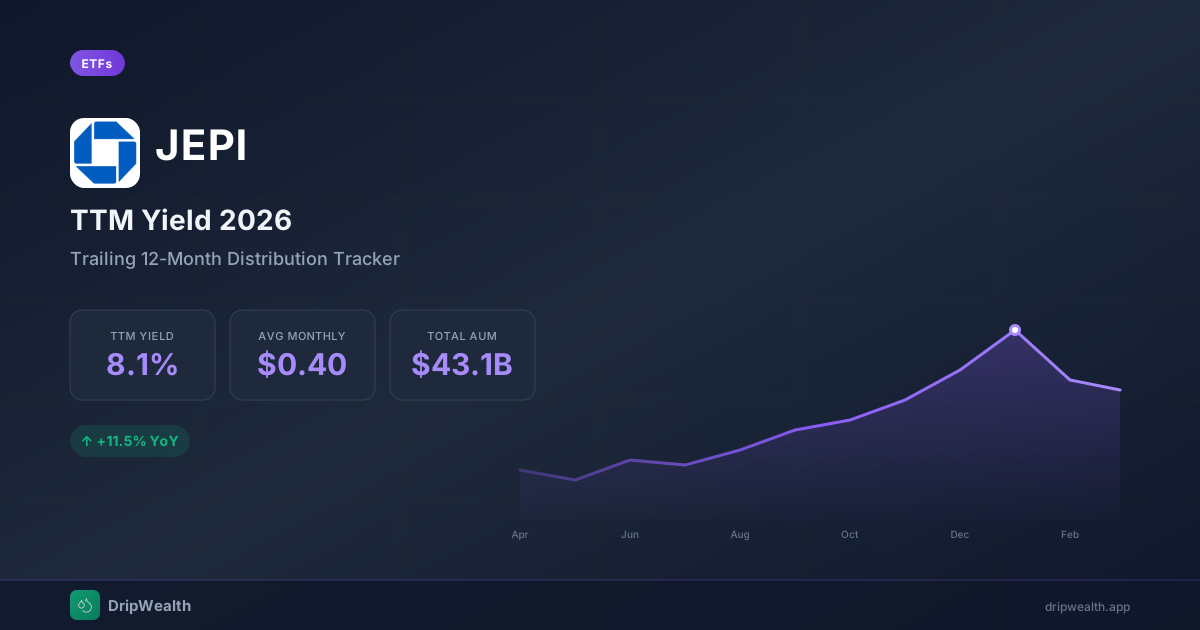
If you own JEPI — or you're thinking about buying — the single most important number to track is the trailing 12-month (TTM) yield. Not the 30-day SEC yield. Not the "forward" yield someone guessed on Reddit. The TTM yield tells you exactly what JEPI actually paid over the last year, divided by today's price.
As of March 2026, JEPI's trailing 12-month yield sits at approximately 8.1%. That means for every $10,000 invested, JEPI sent $810 in cash distributions over the past year — paid out in 12 monthly installments.
This article breaks down every payment, how the yield has changed, and what you can realistically expect at different portfolio sizes. We update this regularly so you always have the latest numbers.
What Is JEPI's TTM Yield and How Is It Calculated?
JEPI's trailing 12-month yield is calculated by adding up every distribution paid over the most recent 12 months, then dividing by the current share price. It's the most honest measure of what you actually received.
Here's the math as of March 2026:
TTM Yield Calculation
Sum of last 12 distributions: $4.76 per share
Current share price: $59.11
TTM Yield = $4.76 ÷ $59.11 = 8.06%
This is different from two other yield numbers you'll see quoted:
- 30-Day SEC Yield — A standardized calculation based on the most recent 30-day period. Useful for comparison across funds, but it can swing dramatically month to month for covered call ETFs like JEPI.
- Forward Yield — An estimate based on the most recent payment annualized (last month × 12). This overstates yield after a good month and understates it after a low month.
The TTM yield smooths out JEPI's natural month-to-month variation, giving you the most reliable picture of actual income. For a deeper dive into JEPI's complete history and strategy, see our full JEPI dividend guide.
Track your JEPI monthly distributions with DripWealth
Add JEPI to DripWealth and we'll track every payout, ex-date, and yield change for you — free to start.
Every JEPI Distribution: Last 12 Months (April 2025 – March 2026)
JEPI pays distributions monthly — one of its biggest appeals for income investors who want cash flow that matches their bills. Here's every payment in the current TTM window:
| Month | Record Date | Distribution |
|---|---|---|
| Mar 2026 | Mar 2, 2026 | $0.3513 |
| Feb 2026 | Feb 2, 2026 | $0.3444 |
| Jan 2026 | Dec 31, 2025 | $0.4271 |
| Dec 2025 | Dec 1, 2025 | $0.3706 |
| Nov 2025 | Nov 3, 2025 | $0.3464 |
| Oct 2025 | Oct 1, 2025 | $0.3610 |
| Sep 2025 | Sep 2, 2025 | $0.3683 |
| Aug 2025 | Aug 1, 2025 | $0.3577 |
| Jul 2025 | Jul 1, 2025 | $0.3995 |
| Jun 2025 | Jun 2, 2025 | $0.5400 |
| May 2025 | May 1, 2025 | $0.4879 |
| Apr 2025 | Apr 1, 2025 | $0.4079 |
Notice the June 2025 spike at $0.54 — that's 56% above the lowest month. This variation is normal for JEPI. The fund's income comes from a combination of dividends from its stock holdings and premiums from selling call options. When market volatility is higher, options premiums increase, and JEPI's distributions tend to be larger.
Key insight: JEPI's month-to-month variation is a feature, not a bug. Higher-volatility months generate larger option premiums, which means bigger distributions. The TTM yield smooths this out.
Year-Over-Year: JEPI Distributions Up 11.5% From 2024–2025
One of the biggest questions JEPI investors have: are distributions growing, shrinking, or staying flat? Here's the year-over-year comparison:
That's meaningful growth. On a $100,000 JEPI position, the difference is roughly $830 more in annual income compared to the prior year — without adding a single share.
The improvement was driven primarily by elevated options premiums during mid-2025, when market volatility spiked around tariff uncertainty and geopolitical tensions. JEPI's covered call strategy naturally benefits from these environments — the fund collects higher premiums when the VIX is elevated.
Important context: Unlike traditional dividend stocks, JEPI's distributions aren't "raised" by management — they fluctuate based on market conditions. A good year for distributions doesn't guarantee the next year will be higher. That said, JEPI has been remarkably consistent since launch, with TTM yields staying in the 7–9% range.
JEPI Income at Every Portfolio Size (Based on 8.1% TTM Yield)
This is the table most JEPI investors really want — how much cash you'd receive based on how much you invest. These numbers use the current 8.1% TTM yield and assume reinvesting nothing (pure income).
| Amount Invested | Shares (≈) | Monthly Income | Annual Income |
|---|---|---|---|
| $10,000 | 169 | $68 | $810 |
| $25,000 | 423 | $169 | $2,025 |
| $50,000 | 846 | $338 | $4,050 |
| $100,000 | 1,691 | $675 | $8,100 |
| $250,000 | 4,229 | $1,688 | $20,250 |
| $500,000 | 8,458 | $3,375 | $40,500 |
At $100,000 invested, you'd collect roughly $675 per month — enough to cover a car payment, groceries, or a utility bill entirely from JEPI income. At $250,000, you're approaching $2,000/month in passive income.
Reminder: These projections assume the TTM yield stays at 8.1%. JEPI's actual distributions fluctuate monthly. Your income in any given month could be 15–30% above or below the average. Plan your budget around the average, not peak months.
JEPI vs. JEPQ vs. SCHD vs. S&P 500: Yield Comparison
How does JEPI's current yield stack up against other popular income options? Here's a side-by-side as of March 2026:
| ETF | TTM Yield | Frequency | Strategy |
|---|---|---|---|
| JEPI | ~8.1% | Monthly | S&P 500 stocks + covered calls (ELNs) |
| JEPQ | ~9.5% | Monthly | Nasdaq-100 stocks + covered calls (ELNs) |
| SCHD | ~3.5% | Quarterly | High-quality dividend growth stocks |
| SPY | ~1.3% | Quarterly | S&P 500 index (total return focus) |
JEPI yields roughly 2.3× more than SCHD and 6× more than the S&P 500. But yield isn't everything — JEPI trades some capital appreciation potential for higher current income through its covered call overlay.
JEPI vs. JEPQ: JEPQ currently yields about 1.4 percentage points more than JEPI because Nasdaq-100 stocks are more volatile, which means higher options premiums. But JEPQ also had a larger drawdown in 2022 (~15% vs JEPI's ~12%). If you want higher income with more volatility, JEPQ wins. If you want steadier income, JEPI is the choice. See our detailed JEPQ vs JEPI comparison for the full breakdown.
JEPI vs. SCHD: Completely different philosophies. SCHD focuses on dividend growth — companies that raise their payouts year after year. JEPI focuses on current income. A 30-year-old building wealth might prefer SCHD. A 60-year-old living off income might prefer JEPI. Many investors own both. See SCHD vs VYM vs DGRO for more on dividend growth ETFs.
What Drives JEPI's Yield Up or Down?
Unlike a traditional dividend stock where the company decides how much to pay, JEPI's distributions are driven by market conditions. Three factors matter most:
1. Market Volatility (VIX)
This is the biggest driver. JEPI generates income by selling equity-linked notes (ELNs) — essentially structured call options on the S&P 500. When the VIX is higher, option premiums are more expensive, and JEPI collects more income. The fund's best distribution months typically coincide with VIX spikes above 20.
2. Interest Rates
Higher interest rates generally support higher option premiums, which benefits JEPI. As the Fed holds rates elevated in 2026, this continues to be a tailwind for distributions. If rates drop significantly, expect some compression in JEPI's yield.
3. Dividend Income from Holdings
JEPI holds a diversified portfolio of S&P 500 stocks (typically 100–120 names). The dividend income from these holdings provides a "floor" for distributions — typically around 2% annualized. The remaining 5–6% comes from the options overlay.
JEPI Income Sources (Approximate)
This is why JEPI's beta is only 0.54 — it captures roughly half the S&P 500's movements. You get less upside in strong bull markets, but much less downside in selloffs — plus 8%+ in income regardless.
What to Watch for JEPI's Yield in 2026
Three things that could meaningfully shift JEPI's TTM yield over the rest of 2026:
Fed rate decisions: If the Federal Reserve begins cutting rates more aggressively, options premiums could compress. This would likely reduce JEPI's distributions by $0.02–0.05 per month. The floor from stock dividends remains, but the total yield would drift toward 7%.
Volatility regime: If market uncertainty stays elevated (trade policy, geopolitics, election year dynamics), JEPI benefits. Sustained VIX above 18–20 supports distributions in the $0.38–0.45 range monthly. A return to a calm, low-VIX market (below 14) would push distributions toward $0.30–0.35.
S&P 500 performance: In a strong rally, JEPI's covered calls cap upside but still generate premium income. In a flat or choppy market, JEPI excels — it collects premiums while the index goes nowhere. In a sharp selloff, JEPI's lower beta provides a cushion, though distributions can temporarily dip.
Bottom line: JEPI's TTM yield of 8.1% is above its historical average since launch (~7.5%). The current environment of elevated rates and moderate volatility has been a sweet spot for the fund. Don't bank on 8%+ forever, but the 7–9% range has been remarkably stable across very different market conditions.
Track Your JEPI Distributions Automatically
If JEPI is part of your income portfolio, tracking every monthly distribution — and seeing how it compounds over time — is key to staying motivated and making smart rebalancing decisions.
DripWealth was built specifically for dividend investors who want to see their income grow in real time. Here's what you get:
- → Automatic dividend predictions — see your next 12 months of expected JEPI income
- → Monthly income dashboard — track actual payments as they arrive
- → Portfolio yield calculator — see your blended yield across all holdings
- → Dividend score — quality rating for every stock and ETF you own
- → FI Journey tracker — visualize your path to financial independence
Whether you hold JEPI alongside Dividend Kings like Coca-Cola or pair it with growth ETFs, DripWealth gives you the full picture of your dividend income — past, present, and predicted.