AbbVie (ABBV) Dividend: 3.1% Yield, 52-Year Streak & Guide 2026
Why AbbVie Is Healthcare's Most Reliable Dividend King
In 2023, the pharmaceutical world held its breath. AbbVie's blockbuster drug Humira — which had generated $20 billion in annual revenue at its peak — lost U.S. patent exclusivity and faced a wave of biosimilar competition. For a company that depended on Humira for nearly half its sales, this was supposed to be a catastrophic moment.
It wasn't. AbbVie raised its dividend anyway.
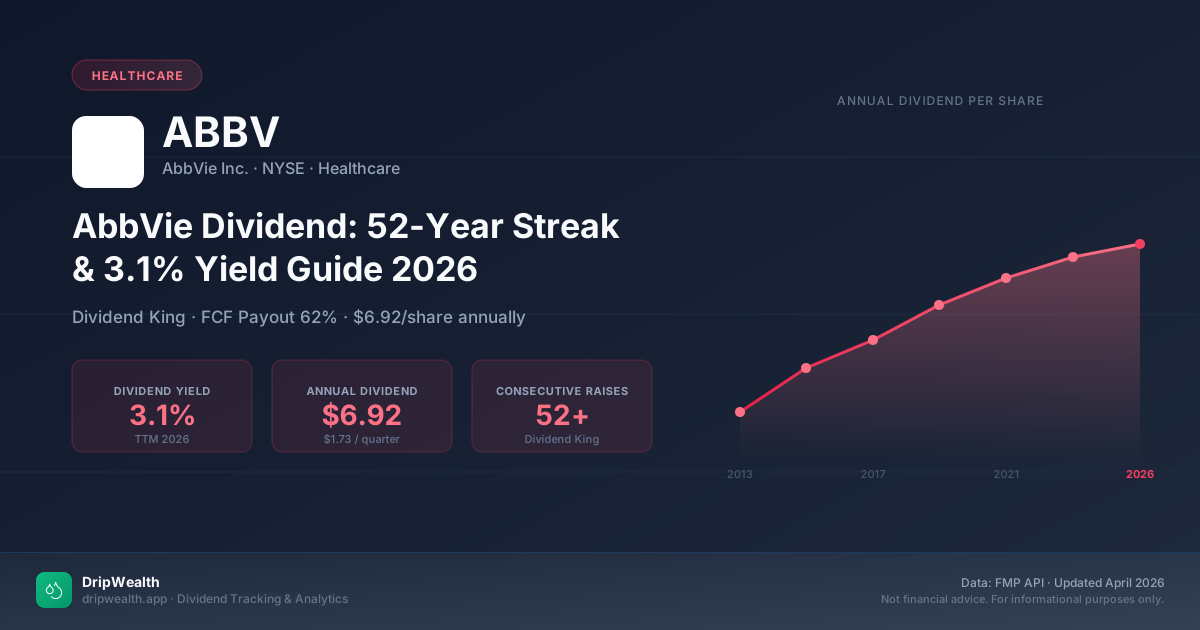
That's the story of AbbVie in one sentence. A company that has raised its dividend every single year for 52 consecutive years — through patent cliffs, acquisitions, global recessions, and a pandemic — and shows no sign of stopping. With a 3.1% yield on $6.92 in annual dividends, it's one of healthcare's most compelling income stocks in 2026.
In this guide, we'll cover AbbVie's complete dividend history, exactly how the Humira patent cliff unfolded (and why ABBV came out stronger), whether the $6.92 annual payout is safe, what growth rate investors can expect, and how much monthly income ABBV generates at different portfolio sizes.
What Is AbbVie's Dividend Yield in 2026?
AbbVie's current dividend yield is approximately 3.1%, based on a quarterly dividend of $1.73 per share ($6.92 annualized) and a stock price around $223. That yield puts ABBV well above the S&P 500 average of roughly 1.3%, while sitting in the comfortable "not too high to be alarming, not too low to be irrelevant" range for income investors.
To understand the yield in context: AbbVie's yield has historically ranged from about 2.8% (when the stock trades at a premium) to over 5% (during selloffs, such as the Humira patent cliff fears of 2023). At 3.1%, you're getting solid income from a Dividend King at a fair — not stretched — valuation.
How yield works: Dividend yield = annual dividend ÷ stock price. At $223 with a $6.92 annual dividend, that's $6.92 / $223 = 3.10%. If the stock falls to $200, the yield rises to 3.46%. If it rises to $250, the yield drops to 2.77%. The dividend itself doesn't change — only the price does.
AbbVie pays dividends quarterly — typically in February, May, August, and November. The most recent quarterly payment was $1.73 per share, announced in Q1 2026 and representing a 5.5% raise over the prior $1.64 quarterly rate. If you own 100 shares of ABBV, you're collecting $173 every quarter — or $692 per year.
Track your AbbVie dividends with DripWealth
Add ABBV to DripWealth and we'll track every payout, ex-date, and yield change for you — free to start.
AbbVie Dividend History: A 52-Year Streak Starting at Abbott Labs
AbbVie's 52-year dividend increase streak is one of the longest in the S&P 500 — and it has a unique origin story. AbbVie was spun off from Abbott Laboratories in January 2013. Abbott had been raising its dividend since 1972. When AbbVie became an independent company, it inherited that streak and has continued raising every year since.
That's the definition of a Dividend King — a company with 50 or more consecutive years of dividend increases. AbbVie earned that status not by decades of standalone history, but by inheriting Abbott's legacy and proving it could maintain the tradition on its own terms.
Here's AbbVie's annual dividend per share from 2015 through 2026:
| Year | Annual DPS | YoY Growth | Context |
|---|---|---|---|
| 2026 | $6.92 | +4.1% | Annualized from Q1 raise |
| 2025 | $6.65 | +7.3% | Raised to $1.73 in Q4 |
| 2024 | $6.20 | +4.7% | ImmunoGen & Cerevel acquired |
| 2023 | $5.92 | +5.0% | Humira biosimilar entry |
| 2022 | $5.64 | +8.5% | Last year of Humira dominance |
| 2021 | $5.20 | +10.2% | COVID recovery, Allergan integrated |
| 2020 | $4.72 | +10.3% | Allergan acquisition ($63B) |
| 2019 | $4.28 | +18.8% | Humira peak revenue era |
| 2017 | $2.56 | +12.3% | Rapid growth phase |
| 2015 | ~$2.00 | — | Early AbbVie years post-spin |
What stands out in this table: AbbVie has never skipped a raise. Not during the 2020 pandemic. Not in 2023 when Humira U.S. biosimilar competition finally arrived. The growth rate has moderated — from 18-19% in the high-growth years to 4-7% more recently — but the commitment to raising hasn't wavered.
Dividend CAGR summary:
- 3-year (2022→2025): 5.6% CAGR
- 5-year (2020→2025): 7.1% CAGR
- Since spin-off (2013→2025, 12 years): ~11% CAGR
Is AbbVie's Dividend Safe? FCF Coverage Analysis
Yes — AbbVie's dividend is well-covered. The company generated approximately $18.7 billion in free cash flow in 2025, while paying out roughly $11.7 billion in dividends. That puts the FCF payout ratio at about 62% — comfortable for a large pharmaceutical company with significant R&D obligations.
Free cash flow coverage matters more than earnings-based payout ratios for pharma companies, because GAAP earnings get distorted by acquisition-related amortization charges. AbbVie has made massive acquisitions — Allergan in 2020 for $63 billion, ImmunoGen and Cerevel in 2024 — and those deals create large non-cash charges that suppress reported net income without affecting actual cash generation.
The one concern worth watching: AbbVie carries meaningful debt from its acquisition spree. Net debt to EBITDA stands at approximately 2.26x — elevated, but manageable for a company generating nearly $19 billion in annual free cash flow. The company has been steadily deleveraging since the Allergan deal closed in 2020.
One risk to monitor: AbbVie relies heavily on Skyrizi and Rinvoq for revenue growth. If either drug faced unexpected safety issues or competitive pressure, revenue growth could slow and constrain future dividend raises. This is a normal pharma concentration risk, not a near-term dividend safety concern — but worth understanding before investing.
Bottom line: with $18.7B in FCF, $7B in headroom after dividends, a strong pipeline, and a 52-year track record of never cutting, AbbVie's dividend ranks among the safest in healthcare.
AbbVie After the Humira Patent Cliff: What Replaced It?
The Humira patent cliff was the most anticipated event in dividend investing in years. When U.S. biosimilar competition began in 2023, Humira revenues started declining rapidly — from $14B+ in the U.S. in 2022 to roughly $3B in 2025. That's a revenue decline of more than $11 billion from a single drug.
Most investors expected a dividend freeze at minimum. What actually happened: AbbVie kept growing revenue, raised the dividend three more times, and is now generating more total revenue than it did during Humira's peak.
Two drugs are responsible for this remarkable transition:
- Skyrizi (risankizumab) — treats plaque psoriasis, psoriatic arthritis, Crohn's disease, and ulcerative colitis. Revenue surpassed $14B in 2025 and is still growing rapidly. It's on track to become one of the best-selling drugs in the world.
- Rinvoq (upadacitinib) — a JAK inhibitor approved for multiple inflammatory conditions. 2025 revenue exceeded $6B and continues to accelerate.
Together, Skyrizi and Rinvoq are on track to generate more revenue than Humira did at its peak. That's not just mitigation — it's replacement and growth.
AbbVie also has two other revenue pillars that most investors underestimate:
- Allergan Aesthetics (acquired 2020 for $63B) — the maker of Botox, Juvederm, and CoolSculpting. Aesthetics is a resilient, cash-generative business with strong consumer brand loyalty.
- Neuroscience — Vraylar (psychiatric conditions) crossed $3B in annual revenue. The 2024 acquisition of Cerevel Therapeutics expands this pipeline further.
AbbVie's 2025 total revenue of $61.2 billion — up from roughly $56B in 2022 — validates the transition. The company that once looked like a one-drug wonder has evolved into a diversified pharmaceutical platform with multiple blockbuster assets.
AbbVie's Dividend Growth Rate: What to Expect Going Forward
AbbVie's dividend growth has slowed from its explosive early years — and that's actually a healthy sign. When the payout was growing 18-20% annually, it was because the company was in a high-growth phase with Humira revenues surging. Now, with a more mature revenue base and a heavier debt load from acquisitions, growth has settled into a 5-8% annual range.
That's the realistic expectation for dividend investors going forward: 5-7% annual raises, roughly in line with expected earnings and FCF growth. Here's how that compares to other Dividend Kings:
| Stock | Current Yield | 5-Yr Div CAGR | Streak | Sector |
|---|---|---|---|---|
| ABBV (AbbVie) | 3.1% | 7.1% | 52+ yrs | Healthcare |
| KO (Coca-Cola) | 2.7% | 4.8% | 62+ yrs | Consumer Staples |
| MCD (McDonald's) | 2.3% | 8.4% | 48+ yrs | Consumer Discretionary |
| PG (Procter & Gamble) | 2.5% | 5.4% | 68+ yrs | Consumer Staples |
AbbVie offers the highest yield among this group and a competitive growth rate. The trade-off is higher business risk from pharmaceutical concentration and drug-patent exposure. For investors who accept that trade-off and want more income than Coca-Cola or P&G offer, ABBV is a compelling alternative within the Dividend King universe.
How Much Monthly Income Does AbbVie Generate?
At a 3.1% yield and $6.92 in annual dividends, here's how much income different portfolio sizes generate from ABBV at today's prices (~$223/share):
| Investment | Shares | Annual Income | Monthly Income |
|---|---|---|---|
| $5,000 | 22 | $152 | $12.70 |
| $10,000 | 45 | $311 | $25.95 |
| $25,000 | 112 | $775 | $64.55 |
| $50,000 | 224 | $1,550 | $129 |
| $100,000 | 448 | $3,100 | $258 |
| $387,000 | 1,735 | $12,000 | $1,000 |
To generate $1,000/month from ABBV alone, you'd need approximately $387,000 invested — or about 1,735 shares at current prices. The math: $12,000 ÷ 3.1% = $387,000.
Of course, almost no one invests $387,000 in a single stock. Most income investors hold ABBV as one component of a diversified dividend portfolio. If ABBV represents 10% of your portfolio, you'd need $3.87M total — but across 10 positions at that scale, the dividend income adds up faster than you might think. Curious how the numbers work out? Try our dividend income calculator.
DRIP tip: AbbVie pays quarterly dividends — not monthly. If you reinvest those dividends via DRIP, you add shares four times per year, compounding your position at each raise. Over 10 years at 7% dividend growth + reinvestment, a $50,000 position could generate over $5,000/year in income rather than the initial $1,550. See our DRIP calculator to model this out.
Is AbbVie a Good Dividend Stock to Buy in 2026?
AbbVie is one of the strongest dividend growth stories in the S&P 500 right now. Here's a balanced look at the case for and against adding ABBV to an income portfolio:
The case for ABBV:
- 52-year streak with no cuts — This company has seen it all and never cut. The Humira cliff was supposed to be the end. It wasn't.
- 3.1% yield with 5-7% growth — The combination of current income and growth is competitive among large-cap income stocks. Not the highest yield, but growing faster than most peers at this yield.
- Low beta (0.33) — AbbVie is remarkably non-volatile for a pharma company. Its stock tends to hold up well in market downturns because healthcare demand is relatively inelastic.
- $18.7B in free cash flow — More than enough headroom to continue raising dividends while paying down acquisition debt.
- Multiple growth drivers — Skyrizi and Rinvoq are still in rapid growth phases. The Allergan aesthetics business and expanding neuroscience pipeline provide diversification.
The risks to understand:
- Drug concentration risk — Skyrizi and Rinvoq together account for a large and growing share of revenue. An unexpected safety issue or competitive drug approval could disrupt growth.
- Acquisition debt — AbbVie has taken on significant debt with its acquisitions. Net debt/EBITDA at 2.26x is elevated, though manageable given cash generation.
- Biosimilar competition — Skyrizi and Rinvoq will eventually face their own patent expirations, though that's likely a decade or more away.
- Valuation — At ~$223 and a 3.1% yield, ABBV isn't cheap. It's trading at a premium to its historical yield range, reflecting confidence in the post-Humira growth story.
Bottom line: AbbVie is best suited for investors who want above-average income from a proven Dividend King, can tolerate some pharmaceutical-sector concentration risk, and have a long time horizon. It's not a "sleep well at night" stock for everyone — pharma has headline risk — but its dividend track record and FCF generation make it one of the most compelling income stocks in healthcare.
How to Track Your AbbVie Dividend Income
AbbVie pays dividends quarterly — typically with ex-dividend dates in January, April, July, and October, with payments arriving 2-4 weeks later. Tracking these alongside other holdings in your portfolio can get complicated fast, especially if you're building a diversified income stream across multiple Dividend Kings and ETFs.
That's exactly what DripWealth is built for. Connect your brokerage, log your ABBV shares, and the app automatically:
- Tracks every dividend payment with the correct per-share amount
- Projects upcoming quarterly payments based on AbbVie's recent history
- Shows your annual and monthly income from ABBV alongside all other positions
- Calculates your portfolio's weighted-average yield and income growth rate
- Earns you badge points toward your dividend rank as your income grows
If you're building toward a specific monthly income goal — say, $500 or $1,000 per month from dividends — the FI Journey tool will show you exactly how many more shares of ABBV (or other holdings) you need to reach it, and when you'll get there based on your contribution rate.
AbbVie has been raising its dividend for 52 years. The goal for dividend investors is to hold it for decades — through the next patent cliff, the next acquisition, the next market scare — and let compounding do the work. Whether you're just starting or already earning hundreds per month from dividends, tracking the details is what separates systematic wealth-builders from passive observers.