Altria Dividend (MO): 6.4% Yield, 55-Year Streak & Safety in 2026
Altria: The Highest-Yielding Dividend King You Can Buy
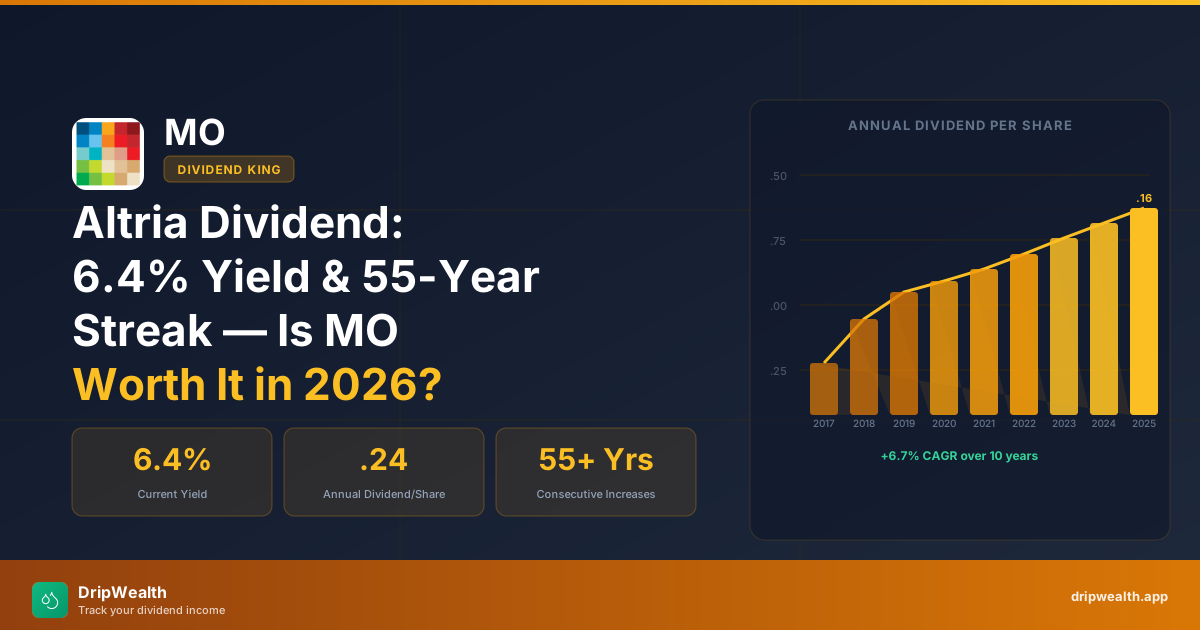
There are stocks that pay good dividends, and then there's Altria.
While most dividend investors celebrate a 3–4% yield with a 10-year growth streak, Altria offers something rare: a 6.4% yield from a company that has raised its dividend for more than 55 consecutive years. That puts it firmly in Dividend King territory — one of fewer than 60 companies in America that can claim 50+ years of consecutive increases.
The source of all this income? Marlboro. The best-selling cigarette brand in America has held roughly 40% market share for decades — a monopoly-like position that generates extraordinary pricing power. When volumes decline, Altria simply raises prices, and the cash keeps flowing.
In this guide, we'll cover Altria's full dividend history, what drives the extraordinary yield, whether the payout is actually safe given declining cigarette volumes, how Altria is pivoting to oral tobacco and vaping, and exactly how much monthly income MO generates at different investment levels.
Altria Dividend History: 55+ Years of Consecutive Increases
Altria's dividend growth record is one of the most remarkable in investing. The company has raised its payout every single year for over five decades — through recessions, tobacco lawsuits, regulatory battles, and declining cigarette volumes. Here's the recent history:
| Year | Annual Dividend/Share | YoY Increase | Quarterly Rate |
|---|---|---|---|
| 2015 | $2.17 | — | $0.5425 |
| 2016 | $2.35 | +8.3% | $0.5875 |
| 2017 | $2.54 | +8.1% | $0.635 |
| 2018 | $3.00 | +18.1% | $0.75 |
| 2019 | $3.28 | +9.3% | $0.82 |
| 2020 | $3.40 | +3.7% | $0.85 |
| 2021 | $3.52 | +3.5% | $0.88 |
| 2022 | $3.68 | +4.5% | $0.92 |
| 2023 | $3.84 | +4.3% | $0.98 |
| 2024 | $4.00 | +4.2% | $1.02 |
| 2025 | $4.16 | +4.0% | $1.04–$1.06 |
| 2026 (current) | $4.24 annualized | +1.9%+ | $1.06 |
The 10-year CAGR from 2015 to 2025 is 6.7%. That's not just inflation-beating — it's genuinely compounding income. An investor who bought $50,000 of MO in 2015 when it yielded around 3.5% would now be collecting roughly $10,000+ per year on their original cost basis.
Dividend Kings status: To qualify as a Dividend King, a company must have raised its dividend for 50+ consecutive years. Altria has cleared that threshold by a comfortable margin. You can see the full list of Dividend Aristocrats and Kings here.
Track your Altria dividends with DripWealth
Add MO to DripWealth and we'll track every payout, ex-date, and yield change for you — free to start.
Is Altria's 6.4% Dividend Actually Safe?
A 6.4% yield raises an obvious question: why is the market offering this much income? High yields often signal doubt about sustainability. Let's look at whether that doubt is justified.
The core of the dividend safety analysis is free cash flow. Altria generated $9.07 billion in free cash flow in 2025. The annual dividend cost, based on roughly 1.68 billion shares outstanding at $4.24/year, comes to approximately $7.1 billion. That's a payout ratio of about 78% of free cash flow.
A 78% payout ratio sounds high — and compared to AT&T's 40%, it is. But for Altria, this is intentional and normal. The company operates a cash-generative, capital-light business with minimal growth capex. It doesn't need to build factories or expand infrastructure. The capital requirements are tiny ($142M in capex in 2024) compared to the $8.6B in operating cash flow.
The 78% ratio has held steady for years precisely because Altria's business model allows it. As long as the tobacco business keeps generating $9B+ in FCF annually — which it has consistently done — the dividend is safe.
What would break the dividend? Altria's FCF would need to drop below ~$7B for the payout to become strained. That hasn't happened in over a decade despite consistent volume declines, because price increases have more than offset the volume losses. It's a structural advantage unique to tobacco.
The Real Risk: Cigarette Volumes Are Declining
Let's be honest about what makes Altria uncomfortable for many investors: people are smoking less.
US cigarette volumes have been declining at roughly 4–5% per year for the past decade. Long-term, that trend isn't reversing. An entire generation of younger Americans has never picked up the habit. Health regulations, higher taxes, and shifting social norms have permanently changed the market.
So why does the dividend keep growing? Three reasons:
- Pricing power. Altria raises cigarette prices every year, typically more than offsetting the volume decline. Net revenue per pack has increased steadily, meaning fewer cigarettes are sold but at significantly higher prices.
- Market share dominance. Marlboro holds ~40% of the US cigarette market. That kind of brand loyalty is extraordinarily rare — it allows Altria to take price without losing disproportionate share.
- Diversification. Altria has been pivoting aggressively into smoke-free products, which we cover in the next section.
The core investment thesis risk: If pricing power ever breaks — meaning consumers start trading down significantly or regulators limit price increases — the FCF math could deteriorate faster than expected. This is the long-term bear case for MO. It's real, but hasn't materialized yet.
Altria's Pivot to Smoke-Free: NJOY and on! Pouches
Altria isn't just sitting still while cigarettes decline. The company has been making deliberate bets on the next generation of tobacco and nicotine products:
NJOY (e-cigarettes): In 2023, Altria acquired NJOY for $2.75 billion — the only e-cigarette brand to receive FDA marketing authorization at the time. NJOY gives Altria a foothold in the vaping market, which is the most direct substitute for traditional cigarettes among younger consumers. Distribution is ramping through retail channels.
on! nicotine pouches: Altria's oral nicotine pouch brand has been growing rapidly. The pouch market (think ZYN competitors) has emerged as a fast-growing segment — smoke-free, tobacco-leaf-free, and appealing to consumers who want nicotine without smoking. on! has been gaining share in a competitive market.
Helix Innovations: Altria also owns the Copenhagen, Skoal, and Husky smokeless tobacco brands through its smokeable division.
None of these products are Marlboro — they don't generate the same margin or volume yet. But they represent Altria's attempt to grow income streams in categories that don't face the same secular volume decline as cigarettes. Success in smoke-free products could extend the dividend growth runway significantly.
How Much Monthly Income Does Altria Generate?
At ~$65 per share and $4.24 annually (4 × $1.06), here's what different investment sizes in MO generate:
| Investment | Shares (~$65) | Annual Income | Monthly Income |
|---|---|---|---|
| $5,000 | 77 | $326 | $27 |
| $10,000 | 154 | $653 | $54 |
| $25,000 | 385 | $1,632 | $136 |
| $50,000 | 769 | $3,261 | $272 |
| $100,000 | 1,538 | $6,521 | $543 |
| $200,000 | 3,077 | $13,046 | $1,087 |
Altria pays quarterly — in March, June, September, and December. That's one of the most attractive payment schedules for income investors because it aligns with quarter-end distributions from many other stocks. A $100,000 position generates over $1,600 every three months — the equivalent of a regular quarterly paycheck.
If you're building toward $1,000 or more per month in dividend income, Altria's high yield means you need less capital to hit income milestones compared to a 2–3% yielder.
Are Altria Dividends Qualified? Tax Treatment Explained
Yes — Altria dividends are qualified dividends for US taxpayers who meet the holding period requirements (holding the stock for at least 61 days within the 121-day window around the ex-dividend date).
This is significant because at a 6.4% yield, the tax treatment has a real impact on net income:
| Tax Bracket | Qualified Rate | After-Tax Yield ($100K) |
|---|---|---|
| Single, under ~$48K income | 0% | $6,521 (full 6.4%) |
| Most middle-income investors | 15% | $5,543 (5.4% net) |
| High earners ($553K+) | 20% | $5,217 (5.2% net) |
Even after a 15% qualified dividend tax, MO still delivers a 5.4% net yield. Most bond funds and high-yield savings accounts don't come close to that after-tax return. For investors in tax-advantaged accounts (IRA, 401k), the full 6.4% compounds tax-deferred or tax-free.
Who Should Own Altria Stock?
Altria is a stock for income investors who can look past the controversy and focus on the fundamentals: exceptional cash generation, a 55-year dividend track record, and one of the most durable competitive moats in American business.
MO makes sense if you:
- Want maximum income yield — 6.4% is hard to beat in a well-established large-cap
- Value dividend growth history — 55+ consecutive increases is elite company (fewer than 60 US stocks qualify as Dividend Kings)
- Understand and accept the secular decline risk in cigarette volumes
- Want low correlation to the market — with a beta of 0.43, MO barely moves when the S&P 500 swings
- Are in a taxable account and can benefit from the qualified dividend tax treatment
MO is not the right fit if you're uncomfortable with tobacco exposure, want aggressive capital gains, or need a company with clean ESG credentials. The ethical considerations around tobacco are real — this is ultimately a personal decision for each investor.
For those building a high-income dividend portfolio, Altria pairs well with lower-yielding, faster-growing dividend stocks like Microsoft or Coca-Cola — balancing immediate income with long-term dividend growth potential.
Track your Altria dividends automatically
Add MO to your DripWealth portfolio and track every quarterly payment, predict future income, and measure your yield on cost over time.
Get Started Free