Best Monthly Dividend Stocks 2026: 12 Stocks and ETFs Ranked
Why Monthly Dividend Stocks Are So Popular in 2026
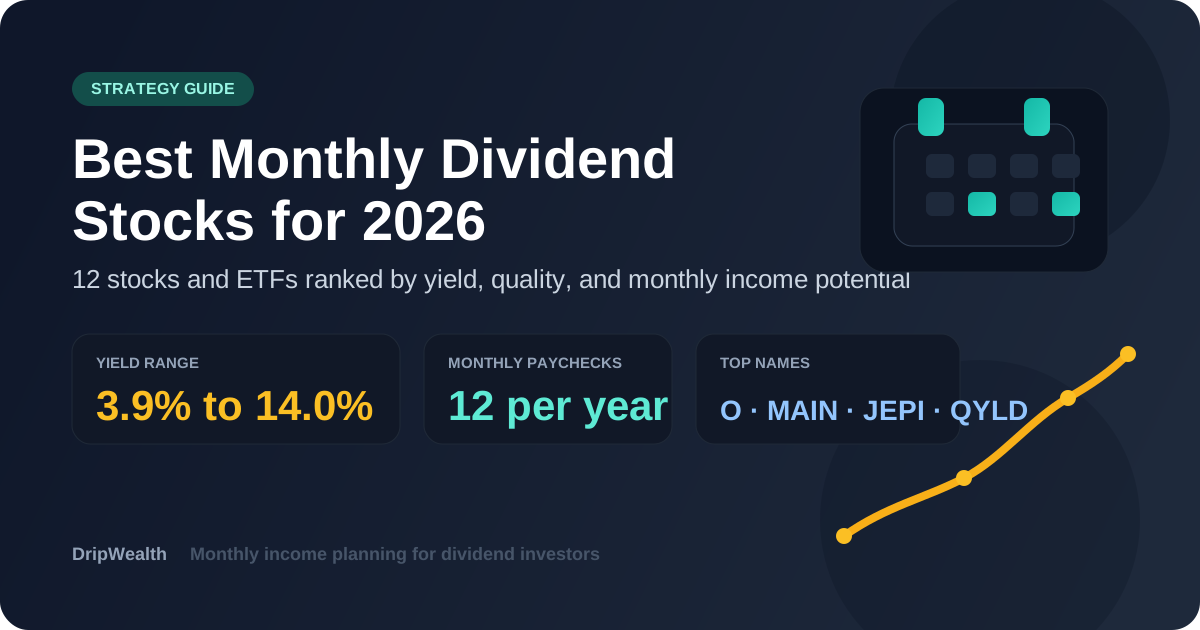
Monthly dividend stocks are popular because they make passive income feel real. Instead of waiting 90 days between payments, you get cash flowing into your account 12 times per year — which is easier to budget, easier to reinvest, and much more motivating when you are building toward financial independence.
That does not mean monthly payers are automatically better. Many of the highest-yielding monthly names are REITs, mortgage REITs, BDCs, or covered call ETFs. Those structures can be excellent income tools, but they come with trade-offs in growth, taxes, and volatility.
This guide gives you the best monthly dividend stocks and ETFs for 2026, grouped by quality and use case. We will also show the math behind $500, $1,000, and $2,000 per month, because that is the number most investors actually care about.
If you want a narrower list focused only on real estate, start with our best monthly dividend REITs guide. If you want covered call ETFs specifically, read our deep dives on JEPI, JEPQ vs JEPI, and QYLD.
What Are the Best Monthly Dividend Stocks in 2026?
The best monthly dividend stocks in 2026 are Realty Income, Agree Realty, Main Street Capital, JEPI, JEPQ, and QYLD if you want the cleanest mix of quality, income, and liquidity. If you want maximum yield instead, names like AGNC and GOOD pay more — but with noticeably higher risk.
Here is the ranked list, using current yield, payout quality, track record, and overall usefulness in a real portfolio.
| Ticker | Type | Yield | Best For |
|---|---|---|---|
| O | Net lease REIT | 5.1% | Best blue-chip monthly payer |
| ADC | Net lease REIT | 3.9% | Lower yield, faster dividend growth |
| MAIN | BDC | ~7.9% | High income with decent quality |
| EPR | Experiential REIT | 6.2% | Balanced income and recovery upside |
| DOC | Healthcare REIT | 7.0% | Healthcare exposure |
| APLE | Hotel REIT | 8.0% | Higher REIT yield |
| SLG | Office REIT | 7.8% | Contrarian office recovery bet |
| GOOD | Commercial REIT | 9.6% | Very high yield, slower quality |
| AGNC | Mortgage REIT | 14.0% | Maximum current income |
| JEPI | Covered call ETF | ~8.0% | Defensive monthly ETF income |
| JEPQ | Covered call ETF | ~11.0% | Higher monthly ETF yield |
| QYLD | Covered call ETF | ~11.9% | Highest yield among liquid monthly ETFs |
Warning: A 12% or 14% yield is not automatically “better” than a 5% yield. High-yield monthly payers often give up growth, take on leverage, or have a history of payout cuts. Income quality matters as much as income size.
The key takeaway is simple: if you want the safest monthly dividends, start with Realty Income, Agree Realty or Main Street, and then layer in ETFs like JEPI or QYLD depending on how much yield you need.
Which Monthly Dividend Payers Are Actually the Best?
The “best” monthly dividend stock depends on what problem you are trying to solve. If you want reliability, the answer is Realty Income. If you want higher current income with still-decent quality, it is Main Street Capital or JEPI. If you want maximum payout right now, it is JEPQ, QYLD, or AGNC — but those come with the biggest compromises.
Here is the practical way to think about the list:
- Best blue-chip monthly stock: O. Realty Income is still the benchmark. It has paid over 630 consecutive monthly dividends and kept increasing the payout through multiple recessions. For most investors, it is the first monthly holding to own.
- Best monthly growth pick: ADC. Agree Realty yields less than O, but its dividend growth has been stronger. If you are younger and do not need maximum yield today, ADC is often the smarter long-term choice.
- Best all-around high-income pick: MAIN. MAIN sits in a sweet spot: higher yield than most REITs, monthly cadence, and a more respectable quality profile than a lot of double-digit yield traps.
- Best monthly ETF for conservative income: JEPI. JEPI yields around 8% and has historically shown smaller drawdowns than QYLD or JEPQ. For retirees, that trade-off matters.
- Best monthly ETF for maximum liquid yield: JEPQ or QYLD. JEPQ gives you higher payout with some tech growth upside. QYLD gives you high monthly distributions but almost no upside capture. They solve different problems.
- Best pure yield: AGNC. AGNC's 14% yield is real, but so is its interest-rate risk and long-term payout erosion. It belongs in the “satellite” bucket, not the foundation of a portfolio.
Best beginner mix: If you are starting from scratch, a simple combination like 40% O, 25% MAIN, 20% JEPI, 15% ADC gives you monthly cash flow without going all-in on the riskiest names.
One current freshness note: older lists still mention STAG Industrial as a monthly payer, but STAG switched from monthly to quarterly dividends in January 2026. That is exactly why readers prefer updated annual guides instead of generic “top 10 monthly stocks” posts that never get refreshed.
Are Monthly Dividends Better Than Quarterly Dividends?
Monthly dividends are better for cash-flow timing and investor psychology, but they are not automatically better investments. The frequency of the payment does not change the underlying economics. A great quarterly payer can still beat a mediocre monthly payer by a wide margin.
Here is the real comparison:
| Factor | Monthly Payers | Quarterly Payers |
|---|---|---|
| Cash-flow rhythm | Best for budgeting and bill matching | Lumpier income pattern |
| Compounding | Slightly faster DRIP cycles | Still excellent if the business grows faster |
| Quality universe | Smaller, more specialized | Much broader and higher quality overall |
| Growth potential | Often lower for high-yield names | Usually better among stocks like MSFT, MCD, KO |
For example, Microsoft pays quarterly, not monthly, but its dividend has grown much faster than most monthly payers. Over a 10- to 20-year period, that higher growth rate can matter far more than getting paid every 30 days.
The most practical solution is not “monthly only” or “quarterly only.” It is a blend. Use a few monthly names for cash-flow consistency, then pair them with stronger quarterly dividend growers like SCHD, Coca-Cola, or Microsoft for long-term compounding.
How Much Money Do You Need for $500, $1,000, or $2,000 Per Month?
The amount of money you need depends entirely on the yield. At a 5% yield, $500 per month requires roughly $120,000. At an 8% yield, it drops to $75,000. At a 12% yield, you only need about $50,000 — but you are usually taking more risk to get there.
Here is the math:
$500/month = $6,000 per year
$1,000/month = $12,000 per year
$2,000/month = $24,000 per year
Required capital = annual income target ÷ dividend yield
| Target | At 5% | At 8% | At 12% |
|---|---|---|---|
| $500/mo | $120,000 | $75,000 | $50,000 |
| $1,000/mo | $240,000 | $150,000 | $100,000 |
| $2,000/mo | $480,000 | $300,000 | $200,000 |
That is why investors get so tempted by names like QYLD, JEPQ, and AGNC. The capital required looks dramatically lower. But higher yield is only helpful if the payout stays intact and the underlying share price does not erode faster than the income helps you.
Tip: Most investors should target a blended portfolio yield, not chase the single highest-yielding stock. A realistic mix of monthly REITs, BDCs, ETFs, and dividend growers often lands around 5.5% to 8% — which is high enough to feel meaningful without pushing all the way into danger territory.
If you want a full walkthrough of the milestone math, read our guide to $500, $1,000, and $2,000 per month in dividends.
What Are the Biggest Risks of Monthly Dividend Stocks?
The biggest risks of monthly dividend stocks are yield traps, slower growth, and tax drag. The payment frequency can distract investors from the fact that some monthly payers are structurally weaker businesses than the best quarterly dividend stocks.
- Yield traps: A 12% or 14% yield can be a warning sign, not a gift. AGNC and GOOD pay a lot today, but both have histories that require closer scrutiny than a blue-chip name like O.
- Limited upside: Covered call ETFs like JEPI, JEPQ, and QYLD produce income by selling away some future upside. That works beautifully in sideways markets. It is less exciting in strong bull markets.
- Tax inefficiency: REIT dividends and covered call ETF distributions are often taxed less favorably than qualified dividends from traditional dividend stocks. That means your after-tax yield can be much lower than the headline number.
- Sector concentration: The monthly universe is dominated by REITs, BDCs, and income ETFs. If you only buy monthly names, your portfolio can become lopsided fast.
The cure is diversification. Own monthly payers for the cadence you want, but keep exposure to higher-quality quarterly growers too. That is exactly why many investors pair monthly holdings with broad dividend ETFs or blue-chip stocks from the Dividend Aristocrats and Kings list.
How Should You Build a Monthly Dividend Portfolio in 2026?
The best monthly dividend portfolio in 2026 is usually a barbell: a core of dependable monthly payers plus a smaller sleeve of higher-yield names. That structure gives you income today without turning the whole portfolio into a yield-chasing experiment.
A simple example for a $100,000 monthly-income portfolio might look like this:
| Allocation | Role | Approx. Yield |
|---|---|---|
| 30% O + ADC | Reliable monthly REIT core | 4%–5% |
| 25% MAIN + EPR | Higher income with still-decent quality | 6%–8% |
| 25% JEPI + JEPQ | ETF-based monthly income sleeve | 8%–11% |
| 20% quarterly growers | Long-term compounding engine | 1%–4% |
That last bucket matters. Monthly income is satisfying, but the long game still belongs to businesses and funds that can grow. Pairing monthly payers with assets like SCHD or strong dividend growers gives you current cash flow and a rising income stream over time.
Once you own the positions, the next job is tracking the actual deposits. That is where most investors lose the plot. They remember the headline yield, but not which payment arrived, which one was cut, or whether the portfolio is truly on pace for its monthly goal.
DripWealth fixes that. You can track monthly and quarterly payouts together, set income goals, and see whether your portfolio is really moving toward the next milestone. If your goal is a paycheck-like dividend stream, visibility is not optional — it is the whole game.
Start with one or two quality monthly payers, avoid the urge to chase every double-digit yield, and build from there. That is the path most investors can actually stick with.