JEPI SEC Yield vs Distribution Yield 2026: Which Number Matters?
Quick Answer: SEC Yield vs Distribution Yield for JEPI
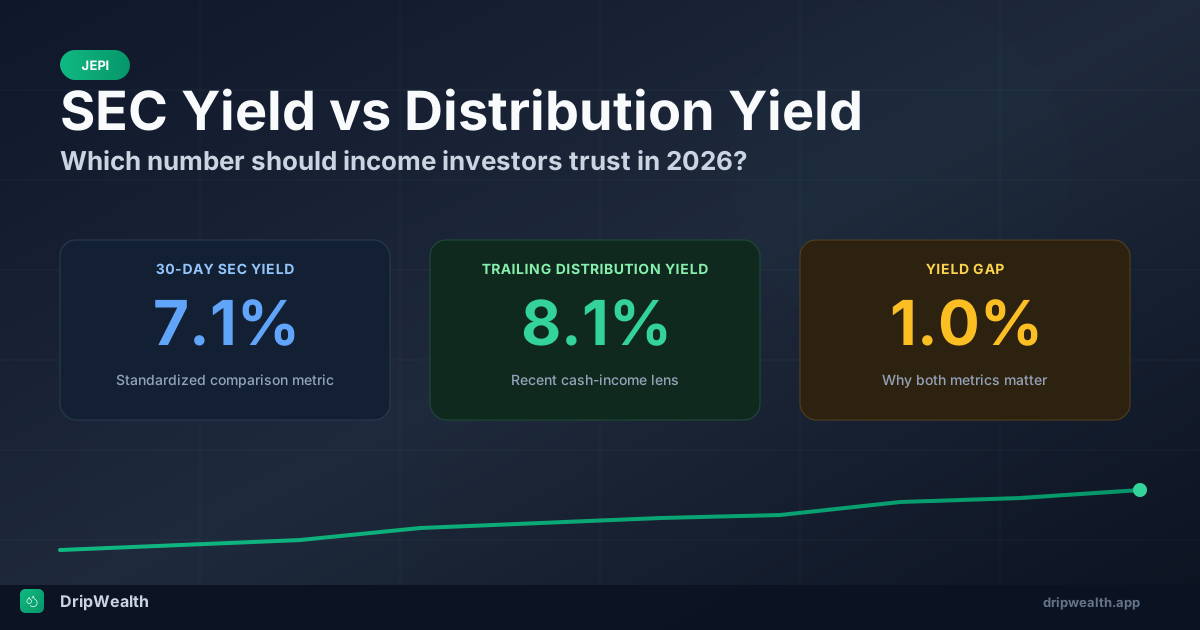
JEPI's distribution yield is usually higher than its 30-day SEC yield because the fund's option-premium income can be lumpy month to month. In early 2026, a practical snapshot is roughly 7.1% SEC yield versus 8.1% trailing distribution yield.
If you only remember one rule, use this: SEC yield is better for comparing funds on a standardized basis; trailing distribution yield is better for estimating your recent cash income.
Info: This article is educational, not personal financial advice. Yields change with price and distributions, so always verify current fund data before investing.
We'll break down each yield metric with plain-English formulas, then show exactly which one to use for retirement planning, ETF comparison, and realistic monthly-income estimates.
What Is JEPI's 30-Day SEC Yield?
30-day SEC yield is a standardized annualized yield formula required by the SEC, based on net investment income over the most recent 30 days, after expenses.
Think of SEC yield as an apples-to-apples comparison metric. It helps you compare JEPI to JEPQ, SCHD, or bond funds using the same methodology, even if distribution schedules differ.
| Metric | What it captures | Best use |
|---|---|---|
| 30-day SEC yield | Recent net investment income annualized | Comparing ETFs consistently |
| Distribution yield | Cash distributions paid to shareholders | Income planning and cash-flow tracking |
For covered-call ETFs like JEPI, SEC yield can look "low" versus headline yield because it does not always fully reflect how option premium timing flows through distributions.
Track JEPI monthly distributions with DripWealth
Add JEPI to DripWealth and we'll track every payout, ex-date, and yield change for you — free to start.
What Is JEPI's Distribution Yield?
Distribution yield measures actual cash paid out to shareholders relative to fund price, usually annualized from trailing distributions (often trailing 12 months).
For JEPI investors focused on monthly income, this is often the more intuitive number because it maps directly to "how much cash did I receive?"
That gap is exactly why so many investors search terms like "JEPI SEC yield 2026" and "JEPI distribution yield 2026." They are both valid metrics, but they answer different questions.
Which JEPI Yield Should You Use for Decisions?
Use SEC yield for comparing funds, and use trailing distribution yield for budgeting income. Most confusion disappears once you separate these two use cases.
- Comparing JEPI vs JEPQ vs SCHD: start with SEC yield plus expense ratio, strategy, and volatility profile.
- Planning monthly cash flow: use trailing 12-month distributions and stress-test with lower distribution scenarios.
- Estimating future income: blend both metrics with market context; avoid assuming a single month repeats forever.
Warning: Many investors annualize the last JEPI distribution and treat it as guaranteed. That can materially overestimate income in calmer markets.
If you want a deeper dive on how JEPI payments behave month-to-month, see our JEPI dividend yield guide and our JEPI trailing 12-month yield tracker.
JEPI Income Math: Practical Example at $100,000
At a trailing 8.1% distribution yield, a $100,000 JEPI position implies about $8,100/year, or roughly $675/month before taxes. At a 7.1% SEC-yield lens, the conservative figure is closer to $592/month.
| Assumption | Annual Income | Monthly Income |
|---|---|---|
| 8.1% trailing distribution yield | $8,100 | $675 |
| 7.1% SEC-yield lens | $7,100 | $592 |
Neither number is "wrong." The first reflects recent realized cash flow; the second is a standardized recent-income measure that can be more conservative in certain environments.
For long-term planning, use a range. Example: plan for $575-$675/month on a $100,000 JEPI allocation, then revise quarterly as distributions and market volatility change.
3 Common JEPI Yield Mistakes to Avoid
The biggest JEPI mistake is treating one yield metric as the whole story. Income ETFs require a multi-metric view.
- Using only the highest headline yield: this can overstate sustainable income.
- Ignoring total return and upside caps: JEPI can lag broad equity indices in strong bull markets.
- Skipping tax context: distribution character can differ from traditional qualified dividends.
If you're comparing income ETFs, pair this guide with our JEPI vs JEPQ comparison and our SCHD yield and growth guide.
The goal is not to find one "perfect" metric. The goal is to build a reliable process that prevents bad assumptions.
Final Takeaway for 2026 Income Investors
JEPI SEC yield and distribution yield should be used together, not against each other. SEC yield keeps comparisons honest; trailing distribution yield keeps your income expectations realistic.
A practical workflow:
- Start with SEC yield to compare ETF options.
- Use trailing distributions for cash-flow planning.
- Apply a conservative range, not a single-point estimate.
If you want to keep this process simple, track your projected and confirmed monthly income in one place. DripWealth can help you monitor JEPI payouts, compare holdings, and update your income plan as market conditions change.